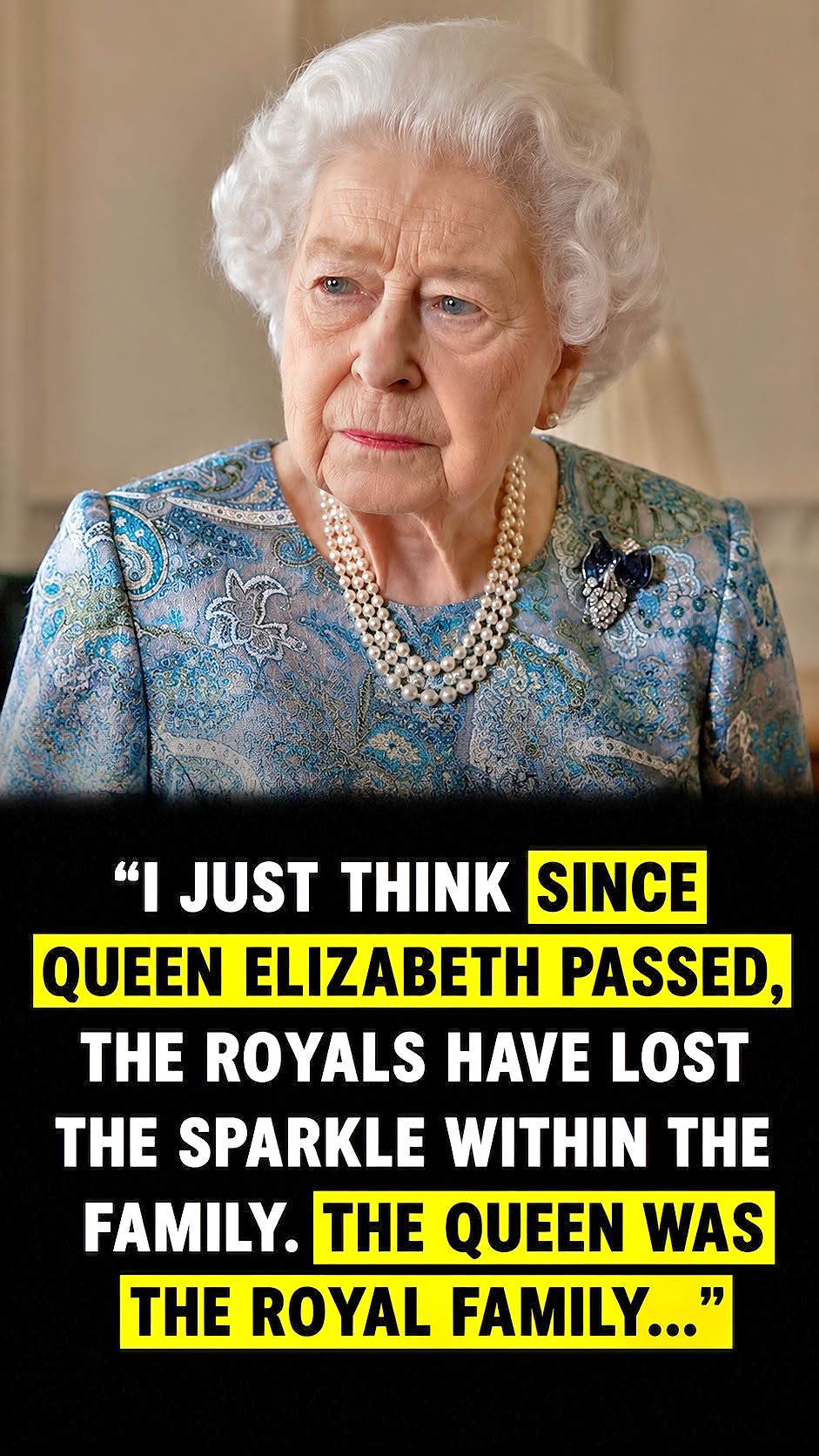
A heartfelt comment from one of our readers has sparked widespread discussion among Royal supporters after receiving hundreds of likes within our community. The reader wrote that since the passing of Queen Elizabeth II, the Royal Family has “lost some of its sparkle,” adding that, to her, the late Queen was the Royal Family.
The comment reflects a sentiment shared by many who admired Queen Elizabeth II throughout her historic reign.

For 70 years, the late Queen served as a symbol of stability, duty, and continuity. Her unwavering commitment to public service, combined with her calm and dignified leadership, earned respect both in the United Kingdom and around the world. For generations, she became the enduring face of the British monarchy.
Her passing in September 2022 marked the end of an extraordinary era. It is therefore understandable that some people feel the monarchy has changed, as the institution continues to adapt under the reign of King Charles III.
At the same time, many Royal observers believe the future of the monarchy remains strong. Much of that optimism centers on Prince William and Catherine, Princess of Wales, who are widely regarded as key figures in the next generation of Royal leadership.
Catherine has earned praise for her dedication to public service, her focus on family, and her composed public presence. Prince William, meanwhile, has gradually taken on greater responsibilities and is increasingly viewed as a steady and experienced future King.
Many Royal supporters believe William’s eventual accession to the throne will mark another historic chapter for the monarchy. While it is impossible to predict how future events will be received, there is little doubt that his coronation would attract significant global attention, reflecting the enduring international interest in the British Royal Family.
Queen Elizabeth II’s legacy extends far beyond her record-breaking reign. Her example of service, resilience, and commitment to duty continues to influence the institution she led for seven decades.
Rather than replacing the late Queen, King Charles III, Prince William, and Catherine are shaping the monarchy’s next chapter while building upon the values that defined Elizabeth II’s reign. As the Royal Family evolves, many supporters hope those principles of service, responsibility, and public trust will continue to guide the Crown for generations to come.
The comment appeared on a quiet evening when most people expected another ordinary discussion about the Royal Family. It was not written by a historian, a journalist, or a royal expert. It was written by a woman who simply missed someone she had never met. Her words were brief, almost hesitant, and perhaps that was why they resonated so deeply. “Since Queen Elizabeth passed away, the Royal Family has lost some of its sparkle. To me, she was the Royal Family.” Within hours, hundreds of people had responded. Some clicked the like button without writing a single word. Others shared memories of coronations, jubilees, Christmas broadcasts, and moments when the Queen seemed to appear during the most important events of their lives. A few disagreed respectfully. But even those who believed the monarchy remained strong admitted that something fundamental had changed in September 2022. The comment became more than an opinion. It became a conversation about memory. It became a conversation about continuity. It became a conversation about what happens when a person who has been present for an entire lifetime is suddenly gone. For many people, Queen Elizabeth II had never been a distant historical figure. She had been a constant. She had been there when grandparents were young, when parents got married, when children were born, and when grandchildren learned to recognize her face on television and on coins. She was the thread that connected generations who otherwise disagreed about almost everything. One supporter wrote, “I’m seventy-three years old. I cannot remember a time when she was not my Queen.” Another replied, “I’m thirty. I also cannot remember a time when she was not my Queen.” The age difference between them was more than forty years. Their memory was the same. That was the extraordinary nature of Elizabeth’s reign. She did not merely witness history. She became part of the way people organized their own personal histories. When people remembered a year, they often remembered what the Queen was doing. The Silver Jubilee. The wedding of Charles and Diana. The fire at Windsor Castle. The death of Diana. The Golden Jubilee. The London Olympics. The Platinum Jubilee. Each event became a marker in millions of lives. The comment spread because it expressed something that statistics could never measure. The monarchy still existed. The institutions remained. The ceremonies continued. The constitutional role endured. Yet for many supporters, the emotional center had shifted. They were not only mourning a monarch. They were mourning familiarity itself. Among those reading the discussion was Margaret Ellwood, a retired schoolteacher living in a small village in North Yorkshire. She had followed the Royal Family for more than six decades. Her living room contained photographs from various royal events, newspaper clippings carefully preserved in albums, and a commemorative mug from the Queen’s Silver Jubilee that had survived three house moves and countless kitchen clear-outs. When Margaret read the comment, she closed her tablet and looked toward the window. Rain tapped softly against the glass. Her husband, David, noticed her expression. “What is it?” She smiled faintly. “Someone wrote that the Queen was the Royal Family.” “And?” “I think they’re right.” David set down his newspaper. “You’ve always liked William and Catherine.” “I do. I think they’ll be wonderful. That isn’t the point.” He waited. Margaret rarely rushed her thoughts. “When I was a little girl,” she said quietly, “my mother woke me early one morning in 1953. She wrapped me in a blanket because the house was cold. We watched the Coronation on a tiny television that belonged to the neighbors. Half the street crowded into one room. People cried. Can you imagine that now?” David nodded. “You’ve told me that story before.” “I know. But I never realized until recently that I’ve been telling the story of my own life through her reign.” She stood and walked to a cabinet filled with albums. The oldest one was worn at the corners. She opened it carefully. Inside was a black-and-white photograph of a young girl holding a paper flag. “That’s me,” she said. “I was nine.” David smiled. “You still have that flag somewhere.” “I do.” She turned another page. Photographs of street parties. Children wearing homemade crowns. Long tables stretching across narrow roads. Neighbors who had since passed away. “You see,” Margaret whispered, “when I look at these, I don’t only remember the Queen. I remember my parents. I remember my brother. I remember people whose voices I can barely hear anymore.” She touched one photograph with her fingertips. “The Queen became part of those memories.” David looked at the album. “So when she died…” “It felt like a door closing.” That sentence lingered between them. A door closing. Not on the monarchy. On an era. Across the country, similar conversations were happening in kitchens, pubs, retirement homes, university dormitories, and online communities. Some were deeply emotional. Others were analytical. Many were both. The question beneath them was simple. Can an institution remain the same after losing the person who embodied it for seventy years? Historians often speak of constitutional continuity. Citizens speak of emotional continuity. The two are not always identical. Professor Adrian Whitmore, a constitutional historian who had spent decades studying the modern monarchy, was invited to speak at a community forum in York. The event was originally planned as a discussion about the future of the monarchy. Instead, it became a discussion about memory. The audience was unusually diverse. Elderly royal enthusiasts sat beside skeptical students. Families attended together. Some had come out of curiosity. Others had come because they still felt unsettled by the Queen’s death. Professor Whitmore began without notes. “People often ask whether the monarchy has changed since 2022. The answer is yes. Of course it has. Every succession changes the monarchy. What is unusual is the scale of the emotional adjustment.” A woman in the front row raised her hand. “Why does it feel so different?” “Because Queen Elizabeth II occupied a unique place in public consciousness. She was not simply a sovereign. She was a long-term presence.” He paused. “Imagine a lighthouse that has stood on the same coastline for seventy years. One day it is replaced. The new lighthouse may function perfectly. It may even be more efficient. But people who grew up with the old one still feel the absence.” The room became very quiet. An elderly man spoke from the back. “My father served during the war. He adored the Queen. When she died, I found him standing in the garden. He was ninety-six. He said, ‘I never thought I’d live to see another monarch.’” Several people wiped their eyes. Professor Whitmore nodded gently. “That is the human dimension of constitutional history. We often focus on institutions. People experience individuals.” After the event, Margaret approached the professor. “I’ve been wondering something.” “Yes?” “Do you think William understands this?” “The weight of memory?” She nodded. Professor Whitmore smiled thoughtfully. “I suspect he understands it better than most people realize.” Margaret looked unconvinced. “He seems so composed.” “Composure is often mistaken for lack of feeling.” He glanced toward the evening sky. “Prince William has spent his entire life watching his grandmother carry a role that most people cannot imagine. He also watched what happened when public expectations collided with private grief.” Margaret thought of Diana. The professor continued. “The next generation faces a different challenge. They cannot become another Elizabeth. They must become themselves.” Those words would stay with Margaret long after she returned home. They must become themselves. It sounded simple. It was perhaps the most difficult task in the world. Because history has a habit of comparing successors to legends. And legends, by definition, are impossible to replace.
Part III: the day the silence reached every home
There are moments that people remember not because of what they were doing, but because of what the world became afterward. Margaret had lived through several of those moments. She remembered the announcement that King George VI had died. She remembered the assassination of President Kennedy. She remembered the Aberfan disaster. She remembered the death of Diana, Princess of Wales. And now she remembered the afternoon of September 8, 2022. She had been watering the roses. The weather was unusually gentle for early autumn. David was inside repairing an old clock that had belonged to his father. The radio was playing softly through the kitchen window. Then the music stopped. A news bulletin began. “At Buckingham Palace, concerns are growing for the health of Her Majesty the Queen.” Margaret froze. It was not the words themselves. It was the tone. She had heard that tone before. Broadcasters become very careful when history approaches. She walked into the house slowly, carrying the watering can as if she had forgotten it was in her hand. David looked up. “What is it?” “They’re worried.” He turned up the volume. The presenters spoke in measured voices. Senior members of the Royal Family were traveling to Balmoral. Regular programming had been interrupted. Television channels began changing their graphics. Reporters gathered outside palaces. The country seemed to inhale and hold its breath. For hours, nothing happened. And yet everything happened. People canceled meetings. Shops quietly turned televisions toward customers. Families sent messages to one another. “Have you heard?” “I’m watching.” “She must be very ill.” Margaret called Emma. “Are you home?” “No, I’m still at work.” “Come home tonight.” There was a pause. “Do you think it’s serious?” “Yes.” Emma arrived just before evening. The three of them sat together in the living room. No one talked very much. The television remained on. Images of Balmoral filled the screen. Rain fell in Scotland. Crowds gathered outside Buckingham Palace. Journalists repeated the same facts because there were no new facts. Waiting became the story. At 6:30 p.m., the announcement came. The words were simple. “The Queen died peacefully at Balmoral this afternoon.” Margaret did not cry immediately. She simply stared at the screen. The sentence felt impossible. The Queen had died. The phrase seemed grammatically incorrect. Like saying that a mountain had retired. David reached for her hand. Emma watched her grandmother more than she watched the television. The announcer continued speaking. King Charles III. The Accession Council. National mourning. Funeral arrangements. Constitutional continuity. Margaret heard almost none of it. She was remembering another living room. Another television. Another generation. Her mother crying during the Coronation. A child wrapped in a blanket. A young Queen beginning a reign that no one imagined would last seventy years. “It’s the end of my whole life,” she whispered. Emma turned quickly. “No, Grandma.” “You don’t understand.” She looked at her granddaughter with extraordinary tenderness. “I don’t mean I’m dying. I mean the world I entered as a child has now completely passed.” That night she could not sleep. Around midnight she walked downstairs and opened the front door. The village was silent. No traffic. No voices. Just a cool breeze moving through the trees. She later learned that many people had done the same thing. They stepped outside for reasons they could not fully explain. They needed to see the world. They needed to confirm that it was still there. The next morning, flowers began appearing outside churches and memorials. Messages were handwritten on cards. “Thank you for your service.” “You were our constant.” “Rest in peace, Ma’am.” Margaret visited the parish church. A table had been placed near the entrance. People were invited to write a few words in a book of condolence. She watched as neighbors entered quietly. Some crossed themselves. Some simply stood in silence. When it was her turn, she wrote slowly. “Thank you for reminding us that duty can be gentle.” She closed the book. An elderly man beside her was struggling to write because his hands were shaking. Margaret recognized him. George Hadley. He had served in the military during the 1950s. “Would you like me to help?” He nodded. “My eyesight isn’t what it was.” She held the book steady while he wrote. When he finished, she glanced accidentally at the page. “I saluted you once. I never imagined I would outlive you.” George closed the book carefully. “I thought she would always be there.” Margaret answered softly. “So did I.” During the days of mourning, something unexpected happened. People who rarely discussed the monarchy began discussing it constantly. Colleagues shared memories. Strangers spoke to one another in queues. Television audiences grew. The funeral preparations became a national ritual. Emma found herself watching far more than she expected. One evening she admitted it. “I didn’t realize how much she mattered until she was gone.” Margaret looked at her. “That happens with people sometimes.” Emma shook her head. “It wasn’t only respect. It was familiarity. She was always in the background. Christmas. Trooping the Colour. Remembrance Sunday. State occasions. It was like a landmark disappearing.” Margaret smiled sadly. “That’s exactly it.” When the funeral finally took place, they watched together. The precision of the ceremony. The silence. The military procession. The crowds lining the streets. The coffin draped in the Royal Standard. The crown resting above it. Margaret noticed something that surprised her. Emma was crying. After the service ended, they remained seated. Neither of them reached for the remote control. Finally Emma spoke. “I think I understand the comment now.” “What comment?” “The one that said she was the Royal Family.” Margaret waited. “I don’t think it literally means no one else matters. I think it means she carried the emotional weight of continuity.” She looked toward the dark television screen. “She connected people who disagreed about politics, generations, culture, and almost everything else. She was one of the few figures who belonged to everyone’s timeline.” Margaret felt an unexpected sense of relief. Not because Emma had become a royal enthusiast. She had not. But because she understood that grief was not always about institutions. Sometimes it was about continuity. A few days later, King Charles addressed the nation. Margaret listened carefully. His voice was steadier than she expected. His tribute to his mother was personal without abandoning the formality of the occasion. When the broadcast ended, David said quietly, “He has a difficult road ahead.” “Yes.” “Do you think people will accept him?” Margaret considered the question for a long time. “They already have constitutionally. Emotionally is another matter.” She looked again at the photographs on the mantelpiece. The Queen at various ages. Young. Middle-aged. Elderly. Smiling. Serious. Waving. Listening. Working. Seventy years compressed into a few frames. “No one succeeds someone like that without being compared to them.” David nodded. “And comparisons are usually unfair.” “Yes.” She looked out the window where autumn leaves had begun to gather beneath the hedge. “The strange thing is that I don’t think Charles is trying to be Elizabeth.” “That’s probably wise.” “It may also be necessary.” For the first time since the funeral, Margaret felt a small shift inside herself. The grief remained. The sense of ending remained. But another possibility was beginning to emerge. History had closed one chapter. It had not closed the book. Somewhere, she thought, a new generation was preparing for responsibilities that had always seemed far away. And among them, one couple carried expectations that grew heavier with every passing month. The future of the monarchy would not be built by recreating the past. It would be built by people who had spent years watching a legend from remarkably close range. And that, Margaret realized, might be both their greatest burden and their greatest advantage.
Part IV: the prince who had been preparing all his life
Prince William was forty years old when his grandmother died. To many people, he still seemed like the young boy walking behind his mother’s coffin. To others, he was already a seasoned public figure with decades of royal experience. Both images were true. That was one of the peculiar realities of William’s life. The public often remembered him in chapters, while he had lived them continuously. Margaret began reading more about the transition after the funeral. Not because she wanted gossip. She wanted perspective. The newspapers were filled with analysis about King Charles III, constitutional procedures, and the future of the Crown. But she found herself drawn repeatedly to stories about William. One article described the increase in his responsibilities. Another examined his role as Prince of Wales. A third focused on the way public expectations had shifted almost overnight. She folded the newspaper thoughtfully. “Do you know what I keep forgetting?” David looked up from his crossword. “What?” “He lost his grandmother.” David nodded. “Everyone keeps talking about the institution.” “So do I.” She sighed. “But for him, it was also personal.” That evening Emma joined them for dinner. She had been spending more weekends in the village than usual. The conversations had become unexpectedly important to her. “I was listening to a podcast on the train,” Emma said. “They were discussing whether William and Catherine are the monarchy’s greatest asset.” Margaret smiled. “That sounds dramatic.” “It was.” Emma laughed. “But they made an interesting point. People often talk about them as if they’re already king and queen.” David raised an eyebrow. “In some ways, the public is always preparing early.” Emma nodded. “The host said William has been preparing for this role since birth.” Margaret looked toward the garden. “I wonder what that does to a person.” The question lingered. What does it do to a child to know that one day the nation will look to him for continuity? What does it do to a young man to know that every success and every mistake will be interpreted through the lens of destiny? Margaret remembered William’s early years vividly. She remembered the photographs of a shy child. The school years. The constant media attention. The unimaginable scrutiny that followed his mother’s death. She remembered wondering whether any child could emerge from that experience with a sense of normality. One rainy afternoon she visited the village library. The librarian, Mrs. Evelyn Porter, greeted her warmly. “I’ve put aside a few books you might like.” Margaret smiled. “You know me too well.” The books were biographies of Queen Elizabeth II, King Charles III, and Prince William. As Margaret gathered them, another patron approached. It was Arthur, the retired naval officer from the community discussion. “Still thinking about the monarchy?” She laughed softly. “Apparently I’ve made it my autumn project.” Arthur held up a biography of William. “This one surprised me.” “In what way?” “It made me realize how long his apprenticeship has been.” They sat near the library window overlooking the village square. Arthur opened the book carefully. “There’s a tendency to think of William as the future. But he’s been working inside the institution for years.” Margaret nodded. “Do you think people underestimate that?” “I think they underestimate the difference between visibility and preparation.” He closed the book. “Elizabeth became Queen suddenly. William has had a lifetime to watch the role from close range.” Margaret considered that. “A lifetime of observation.” “Yes. And a lifetime of expectation.” The library clock chimed softly. Arthur looked toward the shelves. “I met a constitutional scholar years ago. He said something I never forgot. He said the monarchy survives because each generation learns from the previous one, even when the public cannot see the lessons.” Margaret borrowed the books and walked home through streets lined with golden leaves. That evening she began reading. The biographies were filled with details she already knew. Public engagements. Military service. University years. Marriage. Fatherhood. Charitable work. Environmental initiatives. Mental health campaigns. Yet reading them together revealed something different. William’s life was not a series of isolated events. It was a long education. He had observed the Queen’s discipline. His father’s decades of preparation. His mother’s extraordinary public connection. The strengths and vulnerabilities of modern monarchy. The relationship between privacy and duty. The cost of constant attention. Margaret found herself pausing repeatedly. Perhaps the next chapter of the monarchy would not emerge from sudden transformation. Perhaps it would emerge from accumulated experience. The following weekend Emma brought a friend from London named Daniel. He was a journalist who covered social and cultural issues. Over tea, the conversation inevitably turned to the Royal Family. Daniel admitted that he had become fascinated by the public reaction to the Queen’s death. “What struck me,” he said, “was that people weren’t only discussing politics or constitutional questions. They were discussing emotional inheritance.” Margaret looked interested. “What do you mean?” “People kept saying things like, ‘She reminded me of my parents,’ or ‘She was there during every important moment of my life.’ That’s different from ordinary public approval.” David nodded. “She became part of people’s memories.” “Exactly.” Daniel turned to Emma. “And that creates an unusual challenge for William.” Emma asked, “Because he’ll always be compared to her?” “Yes, but also because he belongs to a different emotional era.” He leaned forward slightly. “Elizabeth represented endurance. William may come to represent relatability.” Margaret looked thoughtful. “Is that enough?” “I don’t know.” Daniel smiled. “But institutions evolve through different virtues.” He paused. “The question is whether the public is willing to let him be different.” Later, after Daniel had left, Emma remained unusually quiet. “What are you thinking about?” Emma looked at her grandmother. “I think I’ve been unfair.” “In what way?” “I kept assuming that comparing William to the Queen was a compliment to her. But it might also be a burden for him.” Margaret reached across the table. “That’s a very kind observation.” Emma smiled faintly. “I’m not suddenly becoming a monarchist.” “I know.” “But I’m beginning to understand that public roles can be lonely.” Margaret thought of William and Catherine. They appeared composed. Confident. Purposeful. Yet beneath every public appearance was an invisible weight. Expectation. Comparison. History. Legacy. The next morning, Margaret walked to the churchyard. Autumn had deepened. Leaves covered the paths. She paused near the memorial stone where flowers had been placed after the Queen’s death. Most had faded now. Only a few fresh bouquets remained. She noticed a young mother standing nearby with a small boy. The child looked at the flowers curiously. “Mummy, who are they for?” “The Queen.” “The old Queen?” “Yes.” The boy thought for a moment. “Who is the Queen now?” His mother smiled gently. “We have a King now.” The child seemed satisfied with that answer. He ran ahead toward the gate. Margaret watched them leave. The exchange lasted less than a minute. Yet it contained an entire truth about history. One generation remembers a beginning. Another remembers a transition. A third accepts the present without carrying the same memories of the past. The monarchy would continue to be interpreted through different eyes. Children born today would not remember Elizabeth’s Christmas broadcasts. They would not remember the Platinum Jubilee. They would not remember a world in which she had always been there. Their emotional connection, if one developed, would be shaped by different figures. Different events. Different challenges. As Margaret walked home, she realized that grief had slowly made room for curiosity. She still missed the Queen. She probably always would. But she was beginning to wonder not only what had been lost, but what might eventually be built. Because history was not asking William to become another Elizabeth. It was asking him to become the first William. And somewhere beside him, another figure had been quietly reshaping public expectations in a way that few people fully appreciated. Catherine, Princess of Wales, had entered the Royal Family as a young woman under intense scrutiny. Over the years, she had become something else entirely. Not a replacement for the Queen. Not a mirror of the past. But perhaps the clearest sign that the monarchy’s future would be written in a different voice.
Part V: the woman who learned to stand in the storm
When Catherine first appeared in public alongside Prince William, many people saw a young woman entering a world that seemed impossibly intimidating. They saw the cameras. They saw the scrutiny. They saw the comparisons that inevitably followed every royal relationship. What they could not see was the long education that was quietly taking place behind palace walls. Margaret remembered those early years well. The newspapers rarely showed patience. Every appearance was analyzed. Every expression was interpreted. Every outfit became a headline. “She was so young,” Margaret said one afternoon as she and Emma sorted through old photographs. Emma looked up. “You mean when she married William?” “Yes. People forget that.” Margaret paused. “They talk about her now as if she appeared fully formed. She didn’t. She grew into the role.” Emma nodded thoughtfully. “That’s probably true of most people. We just don’t watch most people growing up in public.” That observation stayed with Margaret. Perhaps one of the most unusual aspects of modern monarchy was that the public witnessed the evolution of its future leaders in real time. The Queen had become Queen suddenly. Catherine became a future queen gradually. The difference mattered. In the months after Elizabeth’s death, Margaret began noticing something she had overlooked before. Whenever Catherine appeared at a public engagement, the conversations around her were different than they had been years earlier. People still commented on her clothing and appearance. But increasingly they spoke about her composure. Her confidence. Her ability to put nervous people at ease. Her attention during conversations. Her calm presence. One Saturday, the village hosted a charity fundraiser for the local hospice. Margaret volunteered at the tea stall. Emma helped organize donations. During a quiet moment, a woman named Helen joined them. Helen had spent twenty years working as a nurse. “I met Catherine once,” she said unexpectedly. Margaret looked surprised. “At a children’s hospice.” “What was she like?” Helen smiled. “The cameras were there for a while. Then they left. She stayed.” Margaret listened carefully. “She sat with a family whose daughter was very ill. There was no speech. No performance. She simply listened.” Helen looked toward the crowd gathered in the village hall. “You can tell when someone has learned that presence matters more than perfection.” Margaret felt something shift. That sentence reminded her of Elizabeth. Not because the two women were identical. They were not. But because the Queen had also understood that small moments often mattered most. Later that evening, Emma asked, “Do you think Catherine is popular because she reminds people of the Queen?” Margaret considered the question carefully. “No.” Emma looked surprised. “I think she is popular because she reminds people of something they admired in the Queen.” “What’s the difference?” “The Queen represented duty expressed through consistency. Catherine represents duty expressed through humanity.” Emma was quiet for a moment. “That’s a beautiful distinction.” “I’m not sure it’s entirely true.” Margaret smiled. “But it feels true.” The following week, Margaret attended another discussion at the community center. This time the topic was “Women and the Modern Monarchy.” The guest speaker was Dr. Eleanor Finch, a historian specializing in royal public life. She began with a surprising observation. “Queen Elizabeth II and Catherine, Princess of Wales, are often compared. In my view, the comparison is useful only if we understand that they were shaped by completely different historical pressures.” Someone asked, “How so?” “Elizabeth was shaped by war, constitutional duty, and institutional continuity. Catherine has been shaped by media culture, public accessibility, and the expectations of emotional transparency.” The audience listened intently. Dr. Finch continued. “The Queen’s strength was often interpreted as restraint. Catherine’s strength is often interpreted as connection.” Margaret wrote that sentence in her notebook. After the lecture, she approached Dr. Finch. “Do you think Catherine understands the weight of expectation?” The historian smiled gently. “I think she understands it intimately.” She paused. “People sometimes mistake elegance for ease. They are not the same thing.” That night Margaret could not stop thinking about the phrase. Elegance is not ease. She imagined the countless public engagements. The rehearsals. The preparation. The need to appear calm regardless of personal circumstances. The balancing of motherhood, public duty, and relentless attention. She thought of the Queen during difficult years. She thought of Catherine during hers. Different eras. Different pressures. The same demand that private emotions often yield to public responsibility. Emma visited again the next weekend. She brought with her an old documentary about the Royal Family. They watched it together. The film showed Elizabeth in her younger years. Walking through crowds. Meeting families. Visiting schools. Speaking with volunteers. “She had such extraordinary discipline,” Emma said softly. “She did.” “What strikes me is that she never seemed to make the moment about herself.” Margaret smiled. “That was one of her greatest gifts.” Emma hesitated. “I think Catherine has something similar.” Margaret looked at her granddaughter with quiet surprise. “That’s a significant thing for you to say.” Emma laughed. “I know. A few months ago I barely paid attention.” “What changed?” “I started listening to people instead of headlines.” She paused. “The nurse at the fundraiser. The historian. You. They all described the same quality.” “What quality?” “The ability to make other people feel important.” Margaret felt a quiet satisfaction. Not because Emma had reached the same conclusions. Because she had reached her own. As autumn deepened, the village prepared for Remembrance Sunday. The churchyard was covered with fallen leaves. Poppies appeared on coats and jackets. The annual service drew a larger crowd than usual. Afterward, people gathered outside under a pale afternoon sky. Arthur stood beside Margaret. “I’ve been thinking about William and Catherine.” “Oh?” “We keep talking about whether they can lead the monarchy.” He looked toward the memorial. “I think the more interesting question is whether they can carry memory without becoming trapped by it.” Margaret nodded slowly. “That is interesting.” Arthur continued. “The Queen carried memory because she had lived through so much. William and Catherine must carry memory that belongs partly to other people.” He looked at the names carved into the stone. “History gives every generation a different burden.” As they walked home, Margaret realized that the conversation had moved far beyond admiration or criticism. It had become a meditation on leadership itself. The monarchy’s future would not depend only on popularity. It would depend on whether the next generation could embody continuity in a world that changed faster than ever before. Catherine’s greatest strength, Margaret thought, might not be that she resembled the Queen. It might be that she had learned a similar lesson through different experiences. That dignity could coexist with warmth. That composure could coexist with empathy. That service could be expressed quietly. When she reached home, she opened her diary again. She wrote a single sentence. “The future rarely arrives wearing the clothes of the past.” She closed the book and looked out the window. Somewhere beyond the headlines and ceremonies, beyond the debates and comparisons, a family was still living through grief, responsibility, and preparation. And the next chapter of the monarchy was unfolding not with dramatic certainty, but with the slow, imperfect, deeply human work of becoming ready.
Final chapter: the light that remains
Winter arrived quietly. The village looked smaller beneath the pale sky. The gardens were bare. The roses had been cut back. The bunting from summer celebrations had long since disappeared. Margaret often sat by the window in the late afternoon, when the light faded early and memories seemed to become more vivid than the landscape outside. One evening, Emma found her there with the blue diary resting on her lap. “You’ve finished it, haven’t you?” Margaret nodded. “For now.” Emma sat beside her. “For now?” “There are always more pages.” She smiled gently. “That’s what I’ve learned.” Emma looked at the diary. “What was the last thing you wrote?” Margaret opened it slowly and turned to the final page. Her handwriting was steadier than it had been in months. “I wrote that grief is not a museum. It is a bridge.” Emma read the sentence twice. “I like that.” “I didn’t at first.” Margaret looked out the window. “I thought grief was a room you stayed inside. But it isn’t. If you’re fortunate, it eventually becomes a bridge between what was and what will be.” Silence settled between them comfortably. The clock in the hallway marked the passing minutes with the same steady rhythm it had kept for decades. “So,” Emma asked softly, “do you still think the Royal Family has lost its sparkle?” Margaret did not answer immediately. She watched a neighbor walking slowly home beneath a streetlamp. “I think I was asking the wrong question.” Emma waited. “The sparkle was never really the point.” She closed the diary. “The point was trust.” She turned toward her granddaughter. “For seventy years, Queen Elizabeth gave people a sense that some things could remain steady even while everything else changed. That was the gift.” Emma nodded. “And now?” “Now the gift is different.” Margaret’s voice was calm. “The future of the monarchy will not be measured by whether it recreates Elizabeth’s era. It will be measured by whether it earns trust in its own.” The following spring, the village organized another community gathering. It was not a jubilee. It was not a coronation celebration. It was simply a day for neighbors to come together after a long winter. Children played on the green. Older residents shared stories. Young families spread blankets beneath newly blossoming trees. Margaret watched Emma helping organize a charity raffle. She laughed easily with people of every age. For a moment, Margaret saw her mother in her. Then she saw herself. Then she saw something entirely new. Generations did not replace one another. They carried pieces of one another forward. Arthur joined her on a bench overlooking the village green. “You seem peaceful.” “I think I am.” He smiled. “Reached a conclusion?” “Not exactly.” She looked at the children running across the grass. “I’ve reached an acceptance.” He waited. “I used to think history was about preserving moments.” She paused. “Now I think it’s about preserving values.” Arthur nodded slowly. “Duty. Service. Kindness.” “Yes.” She looked toward the church where the flowers placed after the Queen’s death had long since been replaced by ordinary seasonal arrangements. “The Queen taught those values through constancy. William and Catherine may teach them through connection. Charles may teach them through perseverance. Different people. Different strengths. The same responsibility.” Arthur looked thoughtful. “You know, that sounds hopeful.” “It is.” Margaret smiled. “But hope is not the same thing as forgetting.” As the afternoon drew to a close, the village choir gathered near the church steps. They began singing quietly. The voices were imperfect. Some were strong. Some trembled with age. Children occasionally sang the wrong words. No one seemed to mind. The beauty was in the togetherness. Emma came to sit beside her grandmother. “The choir sounds lovely.” “They do.” Margaret looked around the village. She thought of the Coronation she had watched as a child. The jubilees. The weddings. The funerals. The celebrations. The losses. The conversations that had filled the months since the Queen’s passing. She realized that the comment which had begun everything had not been wrong. It had simply been incomplete. Yes, for many people, Queen Elizabeth II had been the Royal Family. She had embodied its continuity, dignity, and sense of purpose in a way that was extraordinarily rare. But her greatest legacy was not that she made herself irreplaceable. Her greatest legacy was that she devoted her life to something she believed should endure beyond her. Institutions survive through laws. Traditions survive through rituals. But trust survives only through character. That was the inheritance she left behind. Not a guarantee of success. Not immunity from criticism. Not a promise that the future would be easy. An inheritance of duty. An inheritance of restraint. An inheritance of service. As the choir finished, the crowd applauded warmly. The applause was not only for the music. It was for the feeling that communities, like families and nations, continue through shared memory and shared hope. On the walk home, Emma slipped her arm through Margaret’s. “Do you think people will still be talking about the Queen fifty years from now?” Margaret smiled. “Yes.” “How can you be so sure?” “Because truly remarkable lives become part of other people’s stories.” She looked up at the evening sky. “And because the measure of a life is not how long it lasted. It is how many lives it quietly touched.” When they reached the house, Margaret placed the blue diary back in its wooden box. She did not hide it away. She simply returned it to its place. Some memories are meant to be kept. Others are meant to be lived. Before turning off the light, she wrote one final sentence on a small piece of paper and tucked it inside the diary. “The Crown will change. Generations will change. The world will change. But service, offered with humility and courage, is a light that does not belong to one era alone.” She closed the box gently. Outside, evening settled over the village. Inside, the house was quiet. The old clock continued ticking. And somewhere beyond memory, beyond ceremony, and beyond history itself, the next chapter had already begun.
