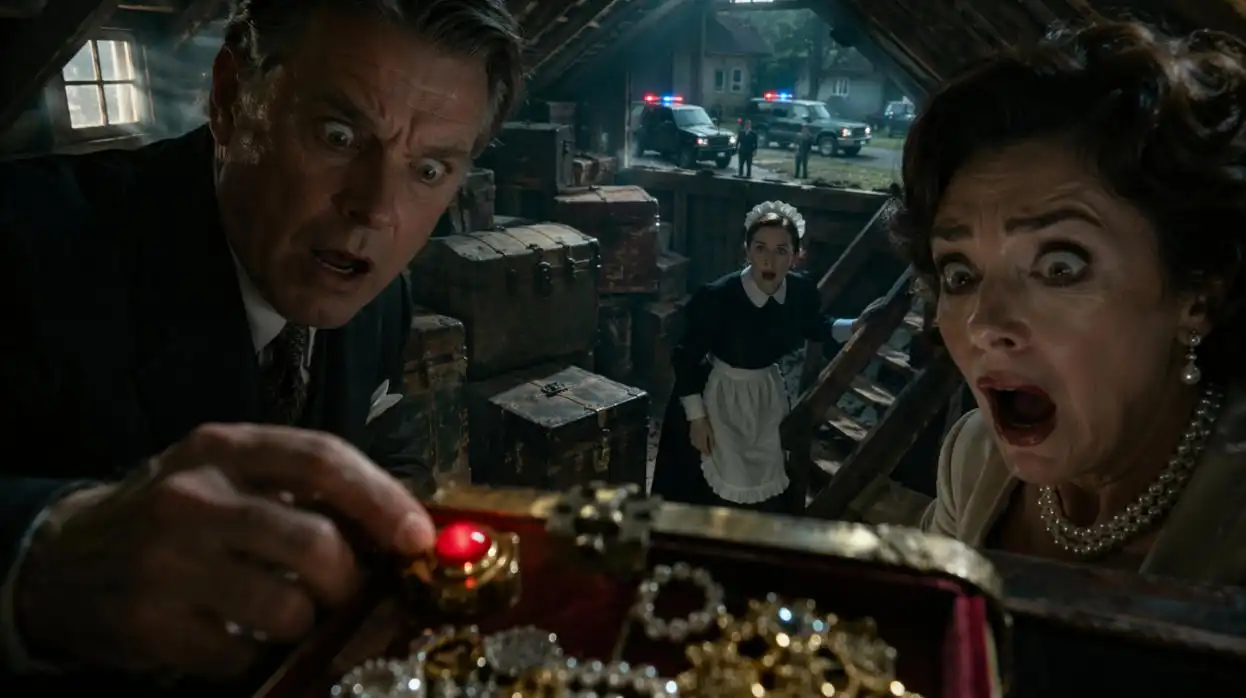
The clasp clicked before the nanny could tear the necklace free.
Not loudly.
Just one tiny metallic sound.
The sort of sound no cruel adult notices until it is far too late.
I was still on the attic floor.
My cheek burned from the slap. My torn dress hung loose at the shoulder. One knee pressed into the splintered wood. And both my hands were wrapped around the jewelry case she thought was worth more than I was.
That was the moment she realized she had not just beaten some blind little girl in a gray attic.
She had just triggered the one piece of evidence designed to destroy her.
My name is Eliana Vale, and I was eight years old when the woman who called me helpless learned that blindness does not mean ignorance.
Sometimes it means no lie gets to hide behind appearances.
I was born into jewels.
Not the shallow kind people wear to be envied.
The real kind.
Stones with lineage. Settings with history. Closures designed by hands long dead. Pieces passed through generations of merchants, royals, collectors, and women who understood that true value is never only in what shines.
My family did not just sell jewelry.
We read it.
We knew how an emerald sat when the cut was honest. How a diamond answered light when its papers were forged. How old platinum felt colder than modern alloy. How a perfect clasp could hold both beauty and secrets.
Then I lost my sight.
People outside the family pitied me too quickly.
They thought blindness had cut me away from the business.
My grandfather disagreed.
He said I had lost distraction, not intelligence.
And he was right.
Without sight, my fingers became ruthless.
I learned texture the way other children learned colors. I learned weight, tension, temperature, balance. I could tell counterfeit gems from genuine ones by minute differences in polish, edge, and setting pressure. I could feel when a hinge had been reopened. When a stone had been switched. When a box had been resealed by the wrong hand.
By eight, I could identify fraud faster than some adult appraisers.
That frightened the wrong people.
Especially the nanny.
She came into the house soft-voiced and smiling, the way dangerous women always do when they know they need to look useful before they look cruel. To outsiders, she was devoted. Caring. Protective of the blind daughter of a great jewel family. Inside the house, she was something else entirely.
She hated that I touched everything.
Hated that I remembered textures. Hated that I knew which family pieces belonged in which drawer. Hated that the old accountant trusted me enough to let me check clasps and cases after inventory.
Because she was stealing.
Not clumsily.
Beautifully.
Small transfers. Quiet substitutions. Fake restoration costs. Insurance manipulations. The kind of theft that survives when a household is too rich to notice tiny wounds until the bleeding adds up.
She thought I would never know.
She thought blindness made me decorative.
What she never understood was that my fingers kept finding the places where her lies had touched the metal.
A necklace put back in the wrong orientation. A hidden spring reset too tightly. A velvet tray lighter by one missing stone. A pendant warmer than it should have been because someone had opened it recently and hidden something inside.
That last one changed everything.
It was an old family piece—a severe, elegant necklace with a central ornament nobody wore anymore because it was considered too historical, too delicate, too valuable. The family thought it was only ceremonial. My grandfather had altered it years before, quietly, after he began suspecting internal theft. Inside the central clasp he built two things: a distress alarm tied to federal cultural-property recovery channels, and a concealed data chamber containing account exports, internal ledgers, and transaction chains proving exactly who had been draining the family holdings.
He never told the whole house.
Only me.
Not because I was easiest to protect.
Because I was hardest to fool.
He said, “If they ever come for the jewels, they’ll really be coming for what the jewels know.”
I never forgot that.
The day everything broke, the house was already tense.
The auditors had sent a second request. A federal liaison had called that morning. The old accountant’s voice was too careful when he said there were discrepancies again.
The nanny knew pressure was closing in.
And desperate thieves make the mistake of becoming impatient.
She came for me in the attic because that was where she always liked to hurt me—upstairs, away from the front rooms, among old trunks and forgotten portraits where she thought screams sounded smaller.
I had the jewelry case with me because I had already decided to take the necklace downstairs to the accountant and ask him to open the clasp in front of witnesses.
She must have guessed.
She slapped me before I reached the door.
Then shoved me against the trunk and called me a stupid blind little burden who didn’t even know what I was holding.
She was wrong twice.
I knew exactly what I was holding.
And exactly what she feared.
When I refused to let go, she cut the shoulder of my dress with embroidery scissors—half punishment, half intimidation, the kind of ugly little act cruel women think proves they still own the room.
Then she lunged for the necklace.
That was when the clasp clicked.
Tiny sound. Huge ending.
Because the clasp did not only open for authorized touch.
It also triggered when forced under distress pressure by the registered heir.
Me.
The alarm traveled silently first. Down the internal system. Out through the house security line. Then farther—to the federal recovery channel attached to the family’s long-standing cultural property file and fraud-watch protection.
The red light inside the jewelry chamber began blinking.
I felt it before anyone saw it.
The nanny froze. Then panicked. Then tried to wrench it from me anyway.
I told her she grabbed it too late.
She laughed.
But fear had already entered her voice.
Then the security panel downstairs screamed.
The maid at the stairwell gasped. The driver shouted from below. And in the distance, through the old house and the heavy afternoon air, I heard something she did not want to believe was real:
vehicle engines turning hard onto the gravel drive.
The FBI arrived with local support fast enough to make panic look stupid.
Not because they knew it was me specifically.
Because they knew what the jewelry signaled: active distress, cultural property compromise, embedded financial evidence, possible internal theft.
By the time they reached the attic, the nanny was still trying to explain, still trying to force a story into shape around her own terror.
The little girl fell. The necklace is fake. She’s confused. She gets upset easily.
Then the senior agent saw my torn dress. Saw the mark on my cheek. And most importantly, saw the clasp light pulsing from inside the necklace in my hands.
That ended her control of the room.
The necklace was opened properly. The hidden chamber inside the clasp released its storage capsule. And the accountant—white-faced, shaking, old enough to hate being proven right—recognized the account codes immediately.
Everything was there.
Diversions. Shell payments. Inventory substitutions. Stolen insurance offsets. Personal accounts tied straight to the nanny’s quiet little empire of theft.
She had not just abused a child.
She had looted one of the most protected jewelry houses in the country while tormenting the one girl whose hands could have exposed her any day she got careless enough.
That was her mistake.
She thought cruelty made me smaller.
It only made me pay closer attention.
They arrested her in the attic.
Not elegantly. Not gently. Not with the dignity she spent years pretending she deserved.
And because the case widened once the first ledgers were authenticated, the rest of her life came apart quickly.
Fraud. Abuse. Possession of stolen cultural assets. Financial corruption. Evidence tampering.
The headlines loved the jewel angle.
The blind girl. The hidden clasp. The stolen fortune. The federal raid.
Fine.
That part glittered.
But the truth was simpler and sharper.
A woman thought blindness made a child easy to lie to.
Instead, it made me the one person in the house who never looked at appearances first.
After her arrest, my family stopped treating me like something fragile to be placed carefully in safe rooms and started doing something better:
they trusted me openly.
I returned to the jewelry tables not as a protected tragedy, but as bloodline.
As future.
As the daughter whose hands could do what others’ eyes missed.
And yes, the family life returned in all the ways stories like to say it does.
The cars. The estates. The polished halls. The world of high names and higher value.
But that was never the part I cared about most.
What mattered was this:
No one ever again tried to tell me I did not know what I was holding.
If you believe anyone who abuses a vulnerable child out of greed deserves the harshest punishment possible, type HER HANDS KNEW THE TRUTH in the comments and share this story. The people who slap a blind little girl and reach for her jewels are often the first ones destroyed when the evidence hidden inside them finally opens.
