On July 8, the monarch welcomed French President Emmanuel Macron and his wife, Brigitte, to Windsor. The 76-year-old was joined by his wife, Queen Camilla, as Prince William and his wife Kate Middleton led the ceremonial start of the French state visit.
While the monarch was all smiles as he greeted the French president and his first lady, many royal watchers observed a visible bloodshot appearance in his right eye. Charles is still completing treatment for an undisclosed form of cancer.
KING CHARLES, PRINCE HARRY AT POINT OF ‘NO TURNING BACK’ AS MONARCH REFUSES RECONCILIATION: EXPERT
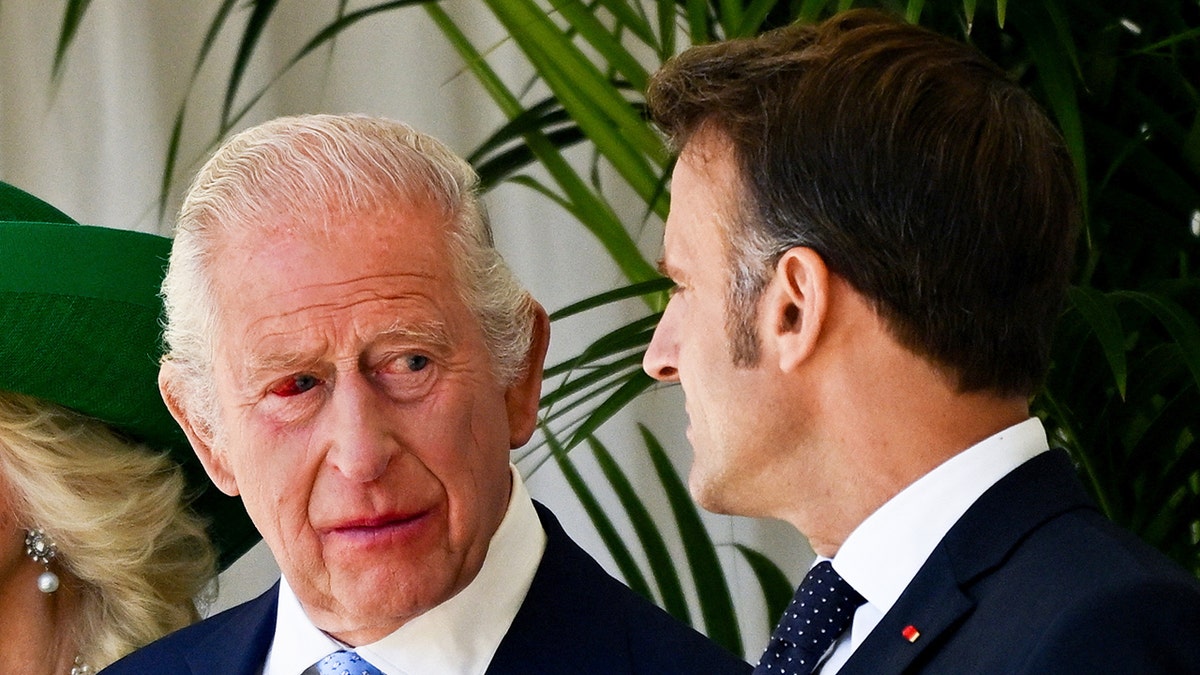
French President Emmanuel Macron speaks to King Charles III, whose eye is red, during a welcome ceremony at Windsor Castle as part of Macron’s state visit to the United Kingdom on July 8, 2025, in Windsor, England. (Dylan Martinez – WPA Pool/Getty Images)
A palace source told Fox News Digital that Charles experienced a burst blood vessel in one eye. They noted it’s unrelated to any other health condition, including his cancer treatment. Fox News Digital reached out to Buckingham Palace for comment.
Charles was diagnosed with cancer in 2024.
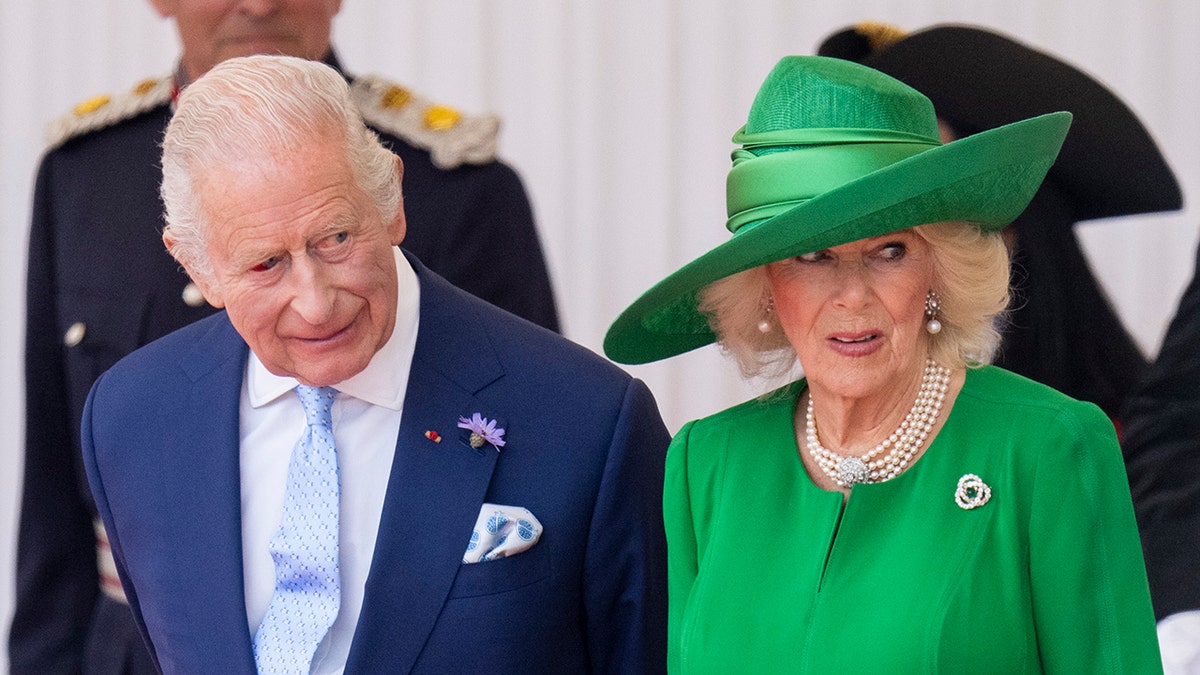
Queen Camilla and King Charles III during the formal welcome at the Royal Dais on July 8, 2025, in Windsor, England. (Mark Cuthbert/UK Press via Getty Images)
A broken blood vessel, or “subconjunctival hemorrhage,” is typically harmless and is similar to having a bruise on your skin, Mayo Clinic reported. According to the outlet, it can be caused by a “strong sneeze or cough” and, while it looks alarming, it clears up on its own within one to two weeks.

Charles didn’t appear to be in any kind of discomfort. Instead, he carried out his royal duties as planned, hosting President and first lady Macron at Windsor Castle with full ceremonial honors, People magazine reported. According to the outlet, a dazzling state banquet is scheduled to take place this evening in St. George’s Hall, with both leaders expected to deliver speeches.
Sources previously told People that the king has been determined to continue public-facing duties as he addresses his health.
CLICK HERE TO SIGN UP FOR THE ENTERTAINMENT NEWSLETTER
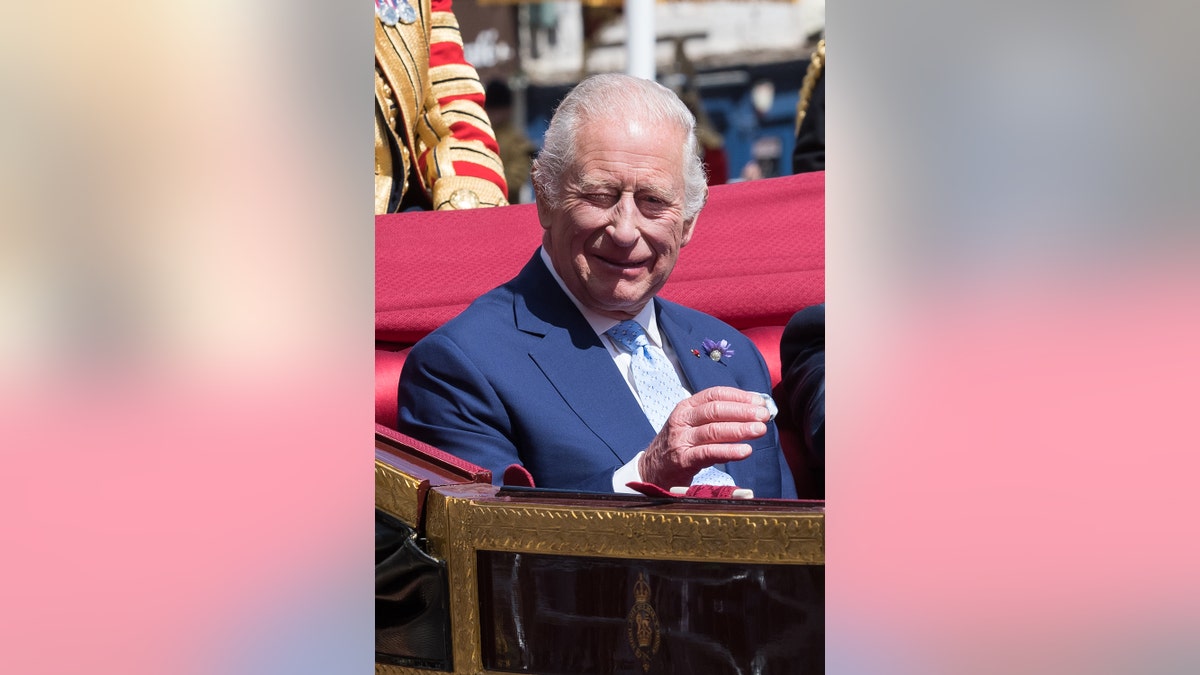
King Charles III travels in a carriage towards Windsor Castle on July 8, 2025. (Wiktor Szymanowicz/Future Publishing via Getty Images)
“The thing you learn about this illness is that you just manage it, and that’s what he does,” a royal aide recently said about Charles’s ongoing treatment.
“Medical science has made incredible advances, and I genuinely see no difference in him,” they shared. “As long as you just do what the doctors say, just live your life as normal as possible. That’s exactly what he is doing.”
Charles wasn’t the only one in good spirits.
PART 2 — THE MOMENT THE PALACE WENT SILENT
The smiles continued as President Emmanuel Macron and Brigitte Macron entered Windsor Castle.
Cameras flashed from every direction.
The ceremony moved forward with the precision expected from one of the world’s most watched royal families.
But behind the polished photographs, attention kept returning to one detail.
King Charles’s right eye remained visibly red.
For the millions watching, it was difficult not to notice.
Some observers immediately worried.
Others reminded themselves that a burst blood vessel can look far more serious than it actually is.
And according to the account attributed to a palace source, that was what had happened.
The king, however, gave no sign that he intended to let the appearance of his eye change the day.
He continued greeting his guests.
He listened.
He smiled.
He stood beside Queen Camilla as the formal welcome unfolded.
Then something happened that few people watching from outside the castle could have anticipated.
Charles turned toward Prince William.
It lasted only a few seconds.
William leaned slightly toward his father.
The king said something quietly.
William nodded.
Neither man appeared alarmed.
But the exchange was enough to make one question linger.
What had Charles said?
Inside the castle, preparations for the state banquet continued.
Staff moved through the corridors.
Tables were checked.
Silverware was positioned.
Flowers were adjusted.
Every detail had to be perfect.
Outside, photographers continued capturing images of the royal family.
Prince William and Catherine were carrying out their ceremonial roles with the calm expected of them.
Yet the atmosphere surrounding the king had changed in the public imagination.
His cancer diagnosis had already made every visible sign of illness subject to intense scrutiny.
A red eye that might otherwise have been dismissed as an ordinary medical occurrence suddenly became the center of attention.
And that was precisely why the palace had reportedly been keen to make clear that the burst blood vessel was unrelated to his cancer treatment.
Still, there was another reason the evening mattered.
Charles was not simply hosting a dinner.
He was demonstrating something he had repeatedly emphasized through his public schedule.
That life, even after a frightening diagnosis, had to continue.
The banquet began.
The chandeliers illuminated St. George’s Hall.
Guests took their places.
Conversation filled the room.
For a moment, the world outside seemed very far away.
Then Charles rose to speak.
The room became quiet.
His voice carried across the hall.
He spoke about the relationship between Britain and France.
He spoke about history.
He spoke about friendship between nations.
And as the cameras focused on him, the same red eye that had caused so much concern earlier was still visible.
But there was no dramatic announcement.
No sudden interruption.
No revelation about his private medical condition.
Instead, there was simply a king performing the duty he had come to perform.
Across the room, Queen Camilla watched him.
Prince William listened.
Catherine remained composed beside him.
And President Macron prepared for his own remarks.
For royal watchers, however, the story did not end when the speeches finished.
Because the next morning, photographs from the banquet began appearing everywhere.
The same question returned.
Was Charles really all right?
The answer required separating what was known from what people merely feared.
What was publicly reported was straightforward.
Charles had been diagnosed with cancer in 2024.
He was continuing treatment.
And on this particular occasion, a palace source said the visible redness in his eye came from a burst blood vessel unrelated to his cancer treatment.
Everything beyond those facts belonged to speculation.
Yet speculation was already spreading.
Some people examined photographs frame by frame.
Others compared images from earlier appearances.
Commentators debated whether the king looked tired.
Still others insisted that his determination to continue working was more important than a temporary physical change.
But there was one thing the photographs could not reveal.
They could not tell the public what was happening inside the private conversations of the royal family.
And that was where the next chapter of the story would become far more personal.
Because while Charles continued his official duties, Prince William was watching more closely than almost anyone realized.
Not because of the king’s eye.
Not because of the cameras.
But because William understood better than most people what it meant when a parent faced a serious illness.
He had already experienced the fear of seeing someone he loved go through a major health crisis.
And as he looked across the room at his father, he knew something the cameras could never capture.
A public appearance could last two hours.
A photograph could last forever.
But neither could show what happened when the doors finally closed.
That night, after the banquet ended and the guests began leaving Windsor Castle, the royal family gradually disappeared from public view.
The corridors became quieter.
The cameras were gone.
The speeches were over.
The ceremony was finished.
But according to the fictionalized continuation of this story, William remained behind for a private conversation with his father.
There were no reporters.
No photographers.
No official statement.
Only a father and son.
And William had one question he had been holding back all day.
“Dad,” he finally said, “are you sure you’re okay?”
Charles looked at him for several seconds.
Then he smiled.
Not the public smile from the ceremony.
A smaller, more private smile.
“I’m doing what I’m supposed to do,” he answered.
William did not immediately respond.
Because he knew that was not quite the same thing as saying everything was fine.
And before either man could continue, someone quietly entered the room with an envelope.
The envelope had been delivered earlier that evening.
It had no royal insignia.
No obvious sender.
Only Charles’s name written across the front.
The king looked at it.
William looked at it.
Neither man spoke.
Then Charles reached for the envelope.
And the moment he opened it, the expression on his face changed.
Whatever was written inside had nothing to do with the red eye.
Nothing to do with the French state visit.
And nothing to do with the ceremony the world had been watching.
It was something much older.
Something deeply personal.
Something that had apparently been waiting for Charles for years.
And William suddenly realized that the most important story of that night had never been visible in the photographs.
It had been sitting inside that envelope.
Waiting.
PART 3 — THE LETTER THAT CHANGED THE NIGHT
Charles unfolded the paper slowly.
William watched his father’s face.
For several seconds, the king said nothing.
The room was completely silent.
Then Charles read the first line again.
His expression softened.
“It’s from an old friend,” he finally said.
William waited.
“What does it say?”
Charles folded the letter once.
Then again.
“It reminded me of something I had forgotten.”
William looked at him carefully.
“What?”
Charles turned toward the window.
Beyond the glass, Windsor was quiet beneath the night sky.
“People spend so much time watching what happens to you,” he said.
“They forget that you are still a person when the cameras disappear.”
William said nothing.
Charles continued.
“An illness can change your schedule.”
“It can change your priorities.”
“But it should not be allowed to decide who you are.”
William lowered his eyes.
For the first time that evening, the tension in his shoulders seemed to disappear.
He understood.
The red eye had frightened people because it was visible.
The cancer diagnosis had frightened them because it was not.
But neither one told the complete story of the man standing in front of him.
Charles placed the letter on the table.
“Tomorrow,” he said, “people will talk about my eye again.”
William smiled faintly.
“They probably already are.”
Charles laughed.
It was a quiet laugh.
A very human one.
“Let them.”
Then he looked directly at his son.
“What matters is that we know the truth.”
And that became the real lesson of the night.
A photograph can show a red eye.
A headline can turn a moment into a crisis.
A worried audience can fill in the spaces where information is missing.
But a photograph cannot show courage.
It cannot show private conversations.
It cannot show the quiet determination required to continue living normally while facing something difficult.
The following morning, the photographs from Windsor were everywhere.
Millions of people saw the same image.
King Charles standing beside President Macron.
Queen Camilla beside him.
Prince William and Catherine carrying out their duties.
And, of course, the unmistakable redness in the king’s eye.
Some people worried.
Some searched for explanations.
Some simply wished him well.
But the most important facts remained simple.
A palace source had said the visible redness was caused by a burst blood vessel.
Such an eye hemorrhage can look dramatic while often being harmless and resolving on its own.
Charles continued his scheduled duties.
There was no dramatic collapse.
No sudden announcement.
No secret medical revelation.
Only another day in the life of a monarch whose health had already become a subject of enormous public attention.
And perhaps that was the part people needed to remember.
Not every frightening photograph contains a frightening secret.
Sometimes a red eye is simply a red eye.
Sometimes a difficult diagnosis does not mean a person has stopped living.
And sometimes the strongest response to fear is not panic.
It is perspective.
As the new day began, Charles prepared for another round of official duties.
The cameras would return.
The questions would continue.
The speculation would never completely disappear.
But inside Windsor Castle, the king already knew something more important.
His life could not be reduced to a headline.
His health could not be understood from a photograph.
And his future could not be written by strangers staring at a screen.
William understood that too.
Before leaving the room, he looked back at his father.
“See you later.”
Charles nodded.
“Of course.”
The door closed.
Charles picked up the letter one final time.
He read the last sentence.
Then he folded it carefully and placed it inside a drawer.
Outside, another morning had begun.
And once again, King Charles stepped forward.
Not because people believed he was invincible.
But because he was human.
And sometimes, continuing forward is the most powerful thing a person can do.
THE END
