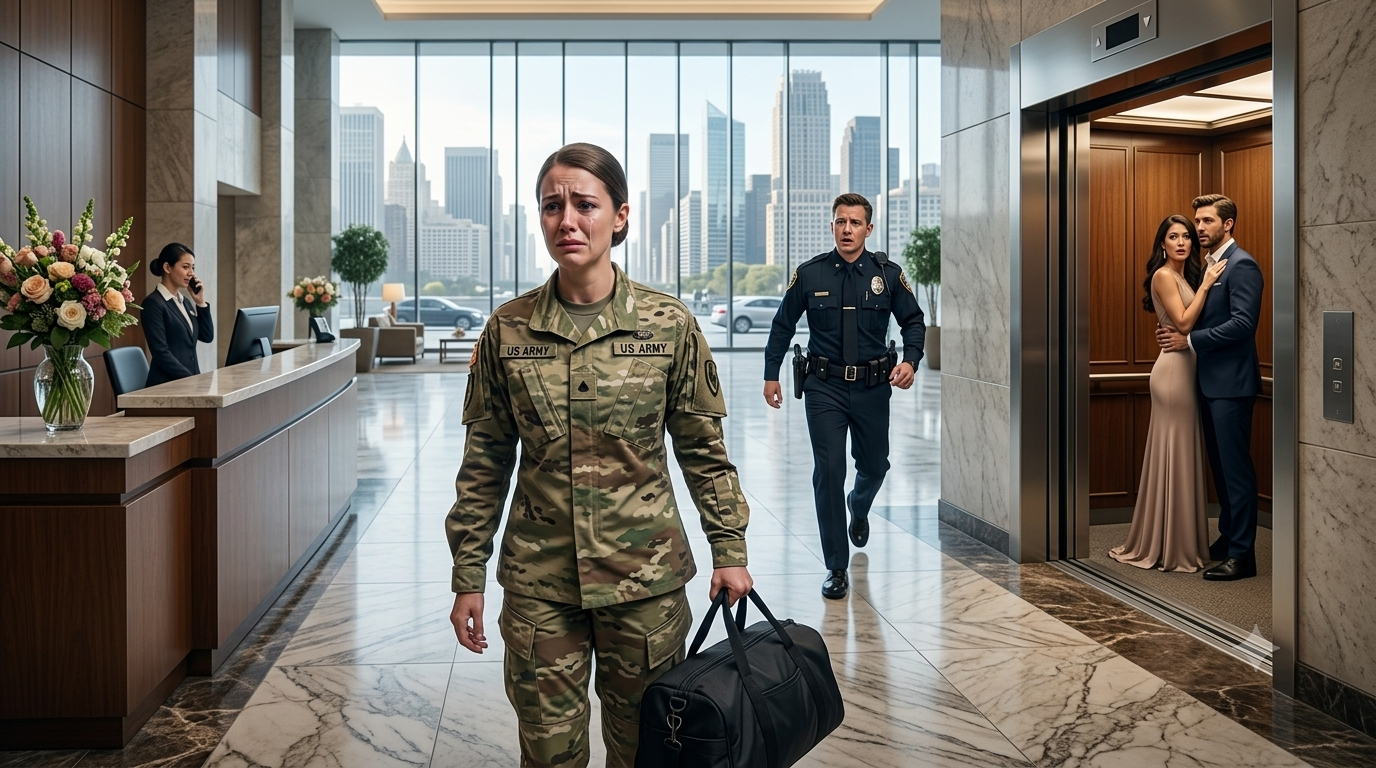
“Ma’am, Mr. Whitmore’s wife is already upstairs.”
The sentence struck Helen Parker like someone had turned off every sound in the lobby at once.
She stood motionless in front of the security desk, dressed in her perfectly pressed U.S. Army formal uniform, her medals lined neatly across her chest, a small black suitcase beside her. She had driven almost three hours from Richmond to Manhattan to surprise her husband, Grant Whitmore, the owner of one of the largest logistics companies in the country.
She had not called first.
She had not sent a text.
She wanted to see him smile.
After twenty-nine years of marriage, long deployments, anniversaries celebrated through video calls, birthdays missed, and years of swallowing loneliness with military discipline, Helen believed they had earned one ordinary moment: walking into his office, watching him rise from his chair, and hearing him say he had missed her.
But the young security guard, looking as if he wanted no part in what was happening, stared at her like she was the one who did not belong there.
“I’m Helen Parker Whitmore,” she said carefully. “I’m Grant’s wife.”
The guard swallowed.
“Yes, ma’am… but Mrs. Whitmore is already on the eighteenth floor. She comes in almost every day.”
Helen did not shout. She did not strike the counter with her hand. She did not cause a scene.
She had learned how to steady her breathing in places far worse than a glass office tower that smelled like expensive coffee.
Just then, the executive elevator doors opened.
A woman stepped out in an ivory dress, elegant heels, and perfectly styled chestnut hair. She moved with the confidence of someone who never needed to ask permission because everyone had already granted it. Two employees stepped aside to greet her.
“Good morning, Mrs. Whitmore.”
The woman smiled.
Helen felt the air scrape against her throat.
It was not the dress.
It was not the way everyone treated her.
It was the pendant around the woman’s neck.
A small antique silver star with a nearly invisible nick along one edge. Grant had given it to Helen the night she was promoted to colonel, when he cried while telling her how proud he was.
The other woman was wearing her medal.
Her name.
Her place.
Her life.
The woman glanced at Helen for less than a second. She did not look confused.
She did not look surprised.
She recognized her.
And she kept walking anyway.
Helen walked out of the building without looking back. She sat on a bench across the avenue beneath the gray New York sky while traffic moved past as if the world had not just split in two.
Her phone vibrated.
It was Grant.
“I miss you, my love. It won’t be long before you’re home.”
Helen stared at the message until the words blurred.
Grant believed she was still deployed in northern Virginia for another month. He had no idea she had been cleared to return early.
Or so she thought.
That afternoon, she checked into a hotel under her maiden name: Helen Parker. She went up to her room, pulled the curtains closed, and opened her laptop.
She searched the company website.
Whitmore National Logistics.
Grant appeared in photographs beside business leaders, politicians, donors, chambers of commerce, and foundations supporting military families. In almost every image, one woman stood next to him.
Vanessa Whitmore.
Founder’s wife.
In one photo, Vanessa was standing in Helen’s own living room, beside the Christmas nativity set Helen had bought in Santa Fe.
In another, she was wearing Helen’s pearl earrings.
In the newest photograph, taken at a gala honoring military veterans, Vanessa smiled beside Grant with the silver star pendant resting at her throat.
Helen closed the laptop with a calmness that frightened even her.
Then her phone rang.
It was her daughter, Madison.
“Mom… are you already back in New York?”
Helen stood up.
“Why are you asking?”
Madison took a shaky breath.
“Dad just called me. He said if you contacted me, I needed to tell him right away.”
Helen stared out the dark hotel window.
Grant already knew she was back.
And in that moment, she understood that what was coming would be much worse than an affair.
Helen asked Madison not to answer any more calls from her father.
She hated dragging her daughter into it. Madison was thirty, had two small children, and a quiet life in Boston. For years, she had carried the burden of having a mother in the military who always promised she would be home soon.
But that night, the lie had already reached everyone.
“Mom, please tell me what’s going on,” Madison pleaded.
Helen closed her eyes.
“I don’t know the whole truth yet. But I need time.”
Then she called Nora Wells, her lifelong friend, a former military investigator and a woman who had never known how to soften the truth.
Nora listened without cutting in.
When Helen finished, she said only:
“Don’t confront him.”
“I wasn’t going to.”
“Good. Grant wants to control the story before you understand the truth. Don’t give him that advantage.”
The next day, Helen rented a gray sedan and parked across from the Manhattan office tower. Wearing sunglasses, a baseball cap, and ordinary clothes, she watched.
For five days.
Vanessa arrived every morning in a white SUV.
An assistant opened the door for her.
One executive brought her coffee.
At noon, Grant came downstairs to meet her, placed a hand on her waist, and escorted her to the private elevators as if they had been doing it for years.
Because they had.
Nora arrived in New York carrying an empty folder, two new prepaid phones, and a bag full of pastries.
“You haven’t eaten,” she said.
“I’m not hungry.”
“That’s exactly why I brought muffins.”
Together, they built a timeline.
Public photographs.
Event records.
Press coverage.
Property records.
Foundation documents.
Visible contracts.