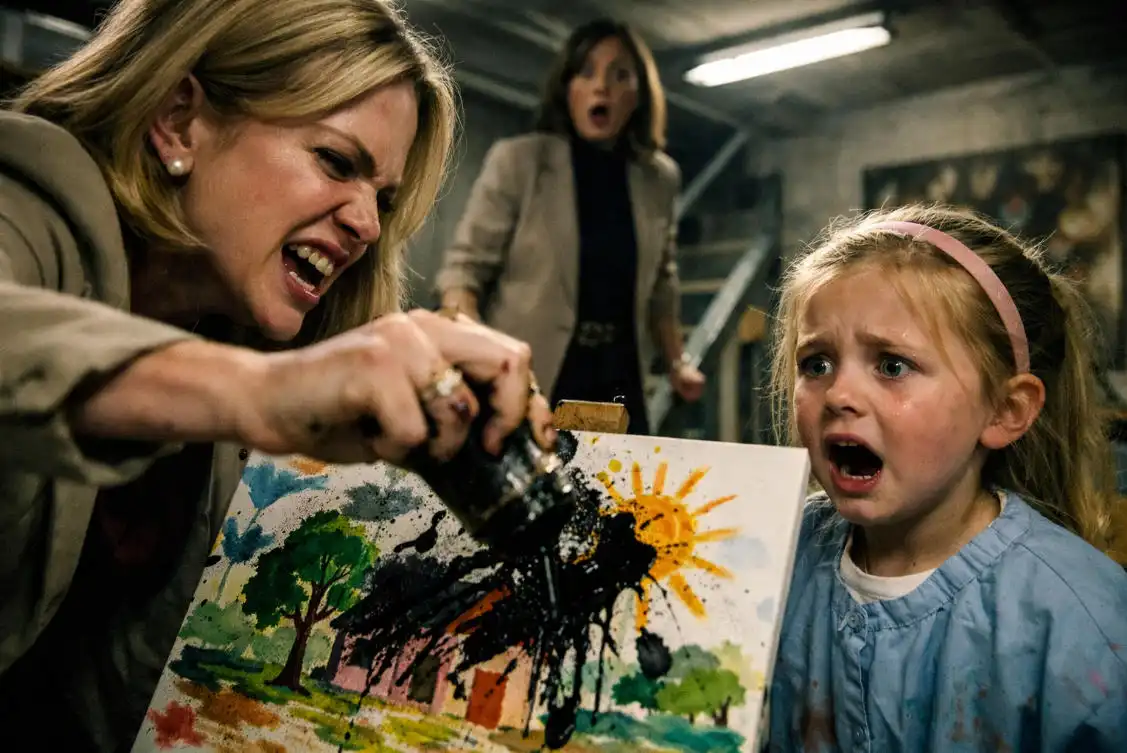
“Who made this?”
The curator didn’t say it to my stepsister.
She said it to the wall.
I was still on the basement floor with ink on my hands, my painting ruined, my brushes crushed under my stepsister’s shoe.
But the woman from the gallery had stopped looking at the destroyed canvas completely.
She was staring at the concrete wall behind me.
At the chalk lines.
The charcoal shadows.
The strange silver-blue wash of light I had rubbed into the cracks with my fingers over weeks and weeks of quiet.
That was the moment my stepsister realized she had not just humiliated the weird little autistic girl she kept hidden downstairs.
She had just revealed the only artwork in the house that truly mattered.
My name is Eliana Vale, and I was six years old when the girl who hated the way I saw the world learned that seeing differently can become the most expensive gift in the room.
People called me difficult when I was small.
Too quiet.
Too focused.
Too upset by noise.
Too calm in ways that made adults uncomfortable.
The word autistic was always spoken in one of two voices around me.
Tenderly by the few who loved me enough to learn me.
Cruelly by the many who wanted to reduce me.
I did not understand all of that at six.
I understood light.
Light on metal pipes.
Light on damp basement walls.
Light on old boxes.
Light on dust.
I understood how shadows softened when evening came and how a narrow window could cut a room in half without touching anything.
That was my language before words felt safe enough to come easily.
After my mother died, my father remarried too quickly.
That is how cruel women enter houses that are already grieving.
My stepmother liked appearances.
My stepsister liked attention.
I liked corners, paper, quiet, and colors no one else noticed.
You can guess which one of us made them uncomfortable.
They called the basement my “studio” when guests came.
That was the pretty word.
The true word was storage.
Gray walls. Low ceiling. Mold smell. Old furniture. Broken lamps. A narrow window too high for me to see through unless I stood on a crate.
That basement was where they put me when I got “too much.”
Too overstimulated. Too silent. Too honest. Too strange for dinner parties.
But they made one mistake.
They left me walls.
And once you leave a child like me a wall and a little light, you have given her a whole universe.
At first I painted on scraps.
Cardboard backs. Shipping paper. Old receipts. The blank sides of my stepsister’s ruined practice sheets.
Then I started painting what the basement did every afternoon between four and five o’clock, when the narrow window threw light across the concrete in one clean angle and the pipes overhead cast shadows that looked like hands, wings, doorways, and faces depending on where you stood.
It was beautiful.
No one else thought so.
That was fine.
I did.
My father was the only one who ever paused long enough to ask what I was painting.
Once, I told him, “The wall when it remembers the sun.”
He looked like he wanted to cry.
That is how I knew he understood some part of me even when he didn’t know how to protect it.
My stepsister, Vanessa, understood something too.
She understood that adults noticed when my paintings were around.
Not because they were sentimental kid art.
Because they made people stop.
That is unbearable to girls like Vanessa.
She wanted applause she could control.
She wanted dresses, applause, compliments, polished smiles.
She painted too, but only the kind of things rich girls learn to paint when they want adults to call them refined.
Flowers that looked borrowed. Women in hats with no souls. Expensive emptiness.
I painted cracks in walls, rain on concrete, the quiet blue of late-day shadow, the bruise-color under old pipes, the loneliness of a chair no one sits in.
Adults remembered mine.
That was the problem.
Then the Louvre youth outreach prize was announced.
An international honor.
Permanent collection review for exceptional emerging work.
The kind of prize people in our town only talked about in dream language, the way they talk about things they never really expect to touch.
Vanessa decided it was hers before she ever painted the entry.
My stepmother decided the same.
They bought better canvases. Better paints. Better frames. And told everyone a great opportunity had finally come for “the talented daughter.”
I was not supposed to enter.
That was never said kindly. It was enforced quietly.
My application form disappeared once. Then my brushes. Then my first finished entry page.
But the maid—sweet brave Anna, who had seen enough cruelty in that house to hate it properly—found one of my basement paintings drying near the boiler room and secretly photographed it for the visiting regional curator scheduled to preview local youth candidates.
That was how the woman from Paris learned about me.
Not from my family. From a servant with eyes.
The day the curator came, I had made a new piece on paper.
A study of window light crossing the basement wall.
It was good.
Maybe even very good.
But the real work was not on the paper.
It was behind it.
Because every day after my stepmother locked me downstairs for being “too sensitive,” I kept drawing directly on the wall.
Softly.
Carefully.
Charcoal from the stove tray. Chalk from broken school pieces. Watered pigment. The heel of my palm. The side of my wrist.
Not graffiti.
Not random scribbling.
A whole composition growing with the wall’s own stains, cracks, mildew blooms, and the changing afternoon light.
I didn’t do it to rebel.
I did it because the wall was already painting itself and I only needed to help it finish speaking.
Vanessa came downstairs before the curator arrived.
She had already seen the house staff carrying my paper piece upstairs by mistake.
She knew someone had taken me seriously.
That was enough.
She smiled the way she always did when she was about to be awful.
Then she took the ink bottle from the supply crate and poured it over my paper.
Black.
Sudden.
Merciless.
I gasped. Reached for it. She slapped me.
Then she stomped my brushes until the handles cracked.
Then she shoved me hard enough that I hit the floor near the wall and the ruined paper slid against the baseboard.
She called me a freak. A basement rat. A damaged little girl pretending to be an artist.
Then she said the ugliest thing:
“No one hangs children like you in museums.”
I told her she ruined the wrong picture.
She laughed.
Then the curator arrived.
Her name was Celeste Moreau.
Tall. Still. The kind of elegant that does not need anyone’s permission.
She came down the steps ready, I think, to be polite about some child’s damaged entry.
Then she saw the wall.
That basement wall.
Alive with shadow memory. A complete work built out of neglect and light. A place transformed by the eye of a child no one respected enough to stop.
She walked right past Vanessa.
Right past the ruined paper.
Right past my stepmother trying to explain what a “difficult child” I was.
She stood in front of the wall for so long nobody else in the room knew what to do with their faces.
Then she said, very softly:
“This is not an accident.”
That was when the truth turned on them.
Because the piece was not only beautiful.
It was important.
Not in the exaggerated way families talk about their children’s hobbies.
In the real way.
The wall used the basement’s natural light shifts as part of the composition. Certain passages disappeared at noon and returned at dusk. The cracks became architecture. The dampness became atmosphere. The curator later called it “a cathedral built from deprivation.”
Vanessa tried lying at first.
Said we painted together. Said the wall was a childish mess. Said I was too young to understand what I had done.
Celeste asked me one question instead:
“When did you know the window would finish the piece?”
I answered immediately.
“Winter light goes lower.”
She went quiet.
That is the silence of recognition.
Not pity. Not surprise.
Recognition.
Then Anna spoke.
Then the driver. Then the accountant, who admitted he had seen bruises and torn sleeves more than once and hated himself for doing nothing.
Once adults believe the gifted child, all the old sins start coming to the surface.
The police came because abuse is abuse even inside rich houses with framed portraits and good china.
My stepsister’s cruelty had left marks. My stepmother’s neglect had records. The basement door had a lock on the outside.
That mattered.
So did the cameras in the hall showing me being sent downstairs over and over again like storage.
Vanessa did not go to prison.
Her mother did.
Abuse. Neglect. Child endangerment.
Vanessa got something else that mattered more to her than jail ever could have:
disinheritance.
My father had more courage in the end than he showed in the middle.
Faced with the truth of what they had done, he cut them both out.
No trust access. No estate share. No protection through the family name.
Vanessa lost the future she had always assumed was waiting for her.
And because the art world heard what she had done—destroying a disabled child’s work, abusing her in secret, trying to steal authorship—no serious gallery ever wanted her polished little emptiness again.
As for me, the Louvre did not take the paper she ruined.
They took the wall.
Or rather, they preserved it in the only way possible.
Laser scans. Pigment mapping. Architectural sectioning. A full conservation team treating a moldy basement wall like the holy thing it had become.
The award letter called it a permanent acquisition of extraordinary environmental work by an emerging artist.
I called it my wall going somewhere brighter.
I did go to Paris later.
Not as a rescued curiosity.
As an artist.
That mattered.
My first solo exhibition opened years later under a title Celeste chose from something I said at six:
When the Wall Remembers the Sun
People lined up around the block.
Critics used too many words. Collectors used too much money. I mostly cared about one thing:
no one could lock me in a basement again and call it kindness.
My stepsister lost her inheritance.
I gained my life.
That is the better ending.
If you believe any person who abuses a vulnerable child out of jealousy deserves to lose every privilege they used as a weapon, type THE WALL WAS THE MASTERPIECE in the comments and share this story. The people who pour ink on a little girl’s art are often the first ones destroyed when the world realizes the true treasure was already behind them. 👇❤️
