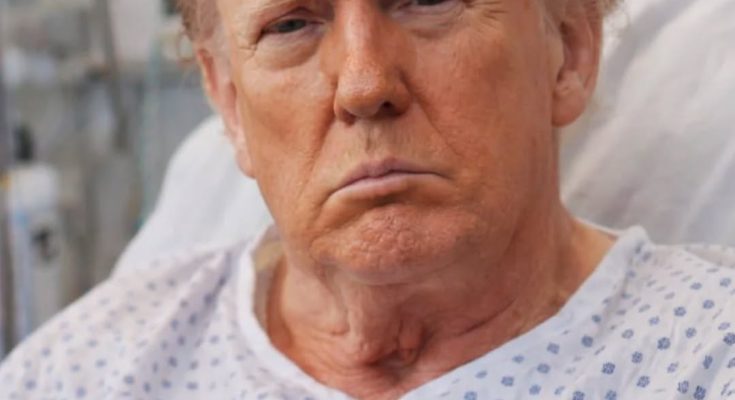
Concerns about the 79-year-old’s health are not new, and they have resurfaced after a fresh bruise appeared on his body.A circular red mark was spotted on President Donald Trump’s left eyebrow on Wednesday, March 11, sparking widespread speculation online about his health. The White House has not commented on the cause.
A Mysterious Red Mark Ignites Online Frenzy
A round red mark could be seen above the president’s left eyebrow as he spoke with journalists before departing the White House alongside US press secretary Karoline Leavitt.Trump has previously been photographed with large, dark bruises on the backs of both his hands, something that has drawn attention in the past.
This time, however, the mark appeared on his face, which quickly fueled concern and curiosity online. Social media users began questioning what might have caused it. One person wrote, “What’s going on in Trump’s left (our right) eyebrow? Is that a new bruise?!”Another commenter remarked on his overall appearance, “Trump’s face today looks downright radioactive.” Other people wondered, “Has he had a fall?”
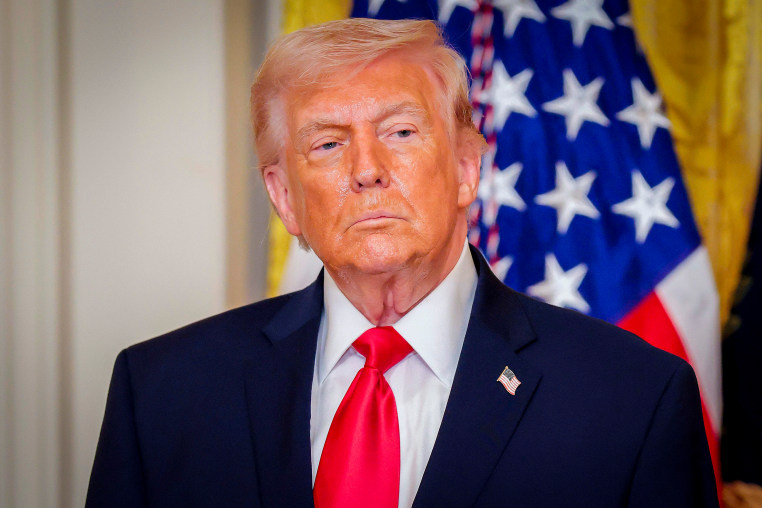
A different netizen took a more sarcastic tone, writing, “Get the Geiger counter out.” Still, one person who saw no need for concern declared, “Dear Leader is Healthier and Stronger than 1000 Men!”
Another Recent Bruise Fuels Health Questions
The eyebrow mark comes just days after another visible bruise drew attention online. On March 2, during a Medal of Honor ceremony held in the East Room of the White House, Trump was also photographed with a bruise on his neck. It rose above the collar of his shirt and stopped just under his ear.
That mark similarly triggered speculation across social media. One observer pointed out the mark in a post that read, “What is this red mark on Donald Trump’s neck? People are speculating online. Is it a skin condition or something else?”
Another commenter asked, “What’s going on here? Is the White House out of Penicillin?” Trump’s personal physician later attributed the neck bruise to a common cream he was reportedly using as part of a preventative skin treatment.
“The President is using the treatment for one week, and the redness is expected to last for a few weeks,” said Dr. Sean Barbabella. The doctor’s explanation did not touch on why Trump needed the skin treatment, thus failing to settle the discussion online.

Reacting to the statement, one person in doubt wrote, “Preventative skin treatment?” Another followed up with a skeptical remark, “What are they preventing?”
Past Injuries and Aspirin Use Offer Possible Clues
In January, Trump was again seen with a noticeable bruise, which he attributed to accidentally bumping his hand on furniture while in Switzerland and applying cream to the area afterward.
The mark was visible on the back of his left hand during a signing ceremony for the “Board of Peace” at the World Economic Forum. Leavitt supported his explanation, noting that the bruise resulted from him hitting his hand on the signing table.
Trump has also said that his use of a high dose of aspirin makes him more prone to bruising. While speaking aboard Air Force One, he explained that aspirin can be beneficial for heart health but may also lead to bruising.
He added that because he takes a higher dose of the medication, doctors have warned him that bruising can occur. Trump further recalled that his doctor had told him he did not necessarily need to take the medication because he was in good health.
However, he said he preferred to continue taking it as a precaution rather than risk potential heart issues. The president’s physician, Barbabella, confirmed that Trump takes 325 milligrams of aspirin daily, noting that the dosage can make it easier for him to bruise.

Guidance from the Mayo Clinic indicates that a low dose of aspirin — often used to help prevent heart attacks or strokes — typically ranges from 75 to 100 milligrams, with 81 milligrams being the most commonly recommended amount.
The same guidance also notes that aspirin therapy generally involves a daily dose ranging between 75 and 325 milligrams.
Previous Medical Diagnosis Returns to the Spotlight
Meanwhile, in July last year, the White House revealed that Trump had been examined after experiencing swelling in his legs and was diagnosed with chronic venous insufficiency.
At the time, the president underwent a comprehensive medical evaluation with the White House Medical Unit that included diagnostic vascular studies. Karoline Leavitt relayed the findings while reading from a note provided by Barbabella.
The physician’s letter, which was later released publicly by the White House, stated that bilateral lower extremity venous Doppler ultrasounds had been conducted. The tests confirmed chronic venous insufficiency. This is a condition described as benign and relatively common, particularly among individuals over the age of 70.
According to Leavitt, the examination was prompted after Trump had noticed mild swelling in his lower legs in the weeks leading up to the evaluation.
The physician’s report indicated that further testing showed no evidence of deep vein thrombosis or arterial disease, and laboratory results were all within normal limits. Trump also underwent an echocardiogram, which did not reveal any signs of heart failure, kidney impairment, or other systemic illness.
Chronic venous insufficiency occurs when valves inside certain veins do not function properly, allowing blood to pool within the veins.
The condition affects about 150,000 people each year, with the likelihood increasing with age. Common symptoms include swelling in the lower legs or ankles, aching or cramping in the legs, varicose veins, pain, and changes to the skin. Treatment options can include medication and, in more advanced cases, medical procedures.
Technical Glitches and a Medical Scare Add to the Drama
Aside from the attention on his physical appearance, people also focused on the technical and unexpected disruptions Trump experienced as he delivered remarks in Kentucky on March 11.
Around the 21-minute mark, the official White House livestream briefly malfunctioned, turning bright green while the president was speaking about Ford Motor Company. Later during the rally, his audio began echoing and overlapping for more than two minutes, making parts of the speech difficult to follow.
His speech was also stopped briefly after a spectator fainted directly behind the president. In the background, an elderly woman appeared to feel unwell before losing consciousness.
People nearby called for medical assistance, prompting Donald Trump to pause his speech for several minutes while emergency medical technicians attended to her. Dr. Oz, who serves as the Trump administration’s Centers for Medicare & Medicaid Services administrator, was also seen assisting.
Moments like these often draw additional attention whenever the president appears in public. Observers frequently focus on everything from his appearance to his conduct and the incidents that unfold during such events.
The photograph appeared on a Wednesday afternoon, and within minutes it had become the only image anyone seemed to be discussing. A small red mark above the left eyebrow. One frame. One close-up. One ordinary moment transformed into a national obsession. The president had stepped out of the White House to speak briefly with reporters before boarding Marine One. The questions were routine. The weather was clear. The cameras were already rolling. Then someone zoomed in. By the time the helicopter had lifted off the South Lawn, screenshots had spread across social media. Commentators circled the mark in red. Influencers enlarged the image. Television producers placed it beside older photographs. Political opponents called it suspicious. Supporters dismissed it as ridiculous. Doctors who had never examined the president were suddenly being quoted everywhere. And millions of strangers began arguing about a bruise that no one could actually explain. In Washington, rumors traveled faster than facts. They always had. But this time something felt different. Not because of the mark itself. Because of what people wanted the mark to mean. Evelyn Mercer had spent thirty-two years photographing presidents. She had documented campaigns, inaugurations, funerals, foreign summits, and moments of history that textbooks would later reduce to a single paragraph. She knew the power of an image. She also knew its danger. A photograph could reveal. A photograph could deceive. A photograph could become evidence for a story that had never happened. She was the one who had taken the picture. When her phone began vibrating nonstop, she was still editing images in the White House press workspace. “Evelyn, did you see what’s happening online?” Her editor sounded exhausted. “I’m looking at it now.” “Every network wants the original file.” She leaned back in her chair. The bruise was visible. That much was true. But photographs were not medical reports. She enlarged the image to two hundred percent. The lighting was harsh. The afternoon sun had created sharp contrast across the president’s face. The mark appeared circular. Reddish. Distinct. She checked the other frames from the same burst sequence. Visible there too. Not a shadow. Not a reflection. Something was there. She exported the images and sent them to her editor. Then she did something almost no one else was doing. She closed the internet. Because she had learned that the first wave of certainty was usually the least reliable. Across town, Daniel Cross watched the photograph appear on six television screens at once. He worked in the West Wing communications office. His job was not to discover the truth. His job was to manage the narrative. Those were not the same thing. He stared at the monitor showing social media trends. The bruise had overtaken every policy announcement from the morning. Every economic headline. Every international development. A tiny red mark had defeated the entire news cycle. His assistant entered without knocking. “They’re asking if we’re issuing a statement.” “Who’s asking?” “Everyone.” Daniel rubbed his temples. “Do we know what caused it?” “No.” He looked out the window toward the South Lawn. This was how Washington worked. Silence created speculation. Speculation created pressure. Pressure demanded explanation. And explanations were often judged not by whether they were true, but by whether they satisfied the public’s imagination. His phone rang. The chief of staff. “Tell me we have an answer.” “We’re checking.” “Check faster.” The line went dead. Meanwhile, in a quiet townhouse in Georgetown, Dr. Nathan Hale watched the same image with professional curiosity. He was a retired vascular specialist who had spent decades treating aging patients. He had no connection to the White House. No access to medical records. No political loyalty. Only experience. His granddaughter, Maya, looked up from her laptop. “Grandpa, everyone’s saying he must have fallen.” Nathan shook his head. “People always say the most dramatic thing first.” “So what do you think?” “I think a photograph is a photograph.” She frowned. “That’s not an answer.” “It’s the only honest one.” He pointed to the screen. “A bruise can have dozens of causes.” “Medication.” “Minor trauma.” “A dermatologic treatment.” “A cosmetic procedure.” “An insect bite.” “Simple skin irritation.” “Or something entirely different.” “You cannot diagnose someone from a compressed digital image.” Maya sighed. “That won’t stop the internet.” “No.” “It won’t.” She watched him carefully. “You sound worried.” “I’m worried about something else.” “What?” “That we’ve forgotten the difference between observation and conclusion.” The evening news opened with the photograph. Panelists debated it for twenty minutes. Some insisted transparency was necessary. Others accused the media of sensationalism. A former campaign adviser declared that every presidential appearance was a matter of public interest. A physician cautioned viewers against speculation. The argument became the story. Not the bruise. The reaction to the bruise. Evelyn sat alone in her apartment and watched people discuss her photograph. They analyzed pixels. They drew circles. They compared timestamps. One commentator claimed the mark had been hidden with makeup in earlier appearances. Another argued it was proof of overwork. A third suggested it was completely insignificant. No one asked the photographer what she had actually seen. She remembered the moment clearly. The president had appeared energetic. He had answered questions. He had walked briskly. Nothing had seemed unusual. If she had not captured the image in high resolution, she might not have noticed the mark herself. That was the strange thing about cameras. They often saw details that human beings missed. At 9:47 p.m., her secure email chimed. The sender had no name. Only an address. The subject line read: “You photographed the wrong thing.” She hesitated before opening it. Inside was a single sentence. “Check frame 1842.” No signature. No explanation. She frowned. Frame 1842 was from the same sequence. She reopened the raw files. 1840. 1841. 1842. She enlarged the image. The bruise was visible. But that was not what caught her attention. In the background, reflected faintly in the glass of a vehicle parked near the driveway, was a figure she had not noticed before. Someone standing apart from the press pool. Watching. Not photographing. Not speaking. Just watching. The figure’s face was obscured by glare. Evelyn zoomed in further. The reflection dissolved into pixels. Meaningless. Or perhaps not. Her phone rang again. This time it was an old colleague from the Secret Service. “I need you to tell me something.” “What?” “Did anyone unusual get close to the motorcade today?” She looked again at frame 1842. “I’m not sure.” There was a pause. Then he said quietly, “Don’t send that frame to anyone else yet.” And for the first time since taking the photograph, Evelyn felt something colder than curiosity. Because the bruise might not be the story after all. The photograph might be. And somewhere in the reflection of a government vehicle, hidden behind a moment that had consumed the country, another story had already begun.
Evelyn locked the editing software and disconnected her laptop from the network before she opened the image again. She had developed habits over three decades in Washington that bordered on superstition. When something felt wrong, she slowed down. When everyone else rushed, she checked timestamps. When anonymous messages arrived, she assumed they had been sent for a reason. Frame 1842 filled the screen. The president stood near the driveway, half-turned toward a reporter who had shouted one final question. The bruise above his eyebrow was visible but subtle. It was not dramatic. It was not the kind of injury that would normally dominate a national news cycle. The reflection in the vehicle window was another matter. She increased the exposure. A distorted silhouette emerged. Tall. Dark coat. No camera around the neck. No press credential visible. The angle was strange. The reflection stretched the figure unnaturally, making it impossible to determine whether it was a man or a woman. But one detail remained clear. The person appeared to be looking directly at Evelyn’s camera. Not at the president. At the lens. A knock interrupted her concentration. She froze. No one visited her apartment unexpectedly. Another knock came, softer this time. She approached the door without turning on the hallway light. “Who is it?” “Daniel Cross.” She did not answer immediately. “I’m alone.” She opened the door halfway. Daniel looked exhausted. His tie was loose, and the expression on his face belonged to someone who had spent the entire day trying to stop a flood with a coffee cup. “You shouldn’t be here.” “I know.” He glanced down the hallway. “Can I come in?” She hesitated, then stepped aside. He entered and immediately noticed the editing software still open on her monitor. “You’re looking at the reflection.” She stared at him. “How do you know about the reflection?” “Because someone else noticed it too.” He remained standing. “I need to ask you a question.” “Go ahead.” “Did you alter that image in any way?” She almost laughed. “You know me better than that.” “I do.” “But I have to ask.” She folded her arms. “What’s going on?” Daniel took a long breath. “Three agencies requested the original files.” “That’s unusual.” “Yes.” “Why?” “They didn’t tell me.” He looked at the screen. “Evelyn, can you zoom in?” She enlarged the reflection again. The pixels broke apart. The figure became less distinct. Daniel leaned closer. “There.” “What?” “The left hand.” She squinted. A small metallic shape caught the light. It could have been a watch. A ring. A key fob. Or nothing at all. “I can’t identify it.” “Neither can we.” “We?” He closed his eyes briefly. “I’ve already said too much.” Silence settled between them. Finally Evelyn spoke. “This is about the bruise.” “No.” “It’s about the photograph.” He met her gaze. “The bruise became a distraction.” “What are you implying?” “I’m saying that sometimes the thing everyone notices is the thing that prevents them from seeing everything else.” She turned back to the monitor. “What was this person doing there?” “We don’t know.” “You’re telling me security doesn’t know who was standing near the motorcade?” “I’m telling you there are gaps.” She looked at him sharply. “There are always gaps.” The words hung in the room. Daniel walked to the window overlooking the quiet Georgetown street. “When I was twenty-six, I believed government was a machine.” He smiled without humor. “Every gear connected to another gear.” “Every answer somewhere in a file.” “Then I came to Washington.” “And?” “It’s a house full of locked rooms.” Evelyn had heard variations of that sentence from senators, journalists, agents, and diplomats. No one ever agreed on who held the keys. Her phone buzzed again. Another anonymous email. This one contained only a photograph. A grainy image of the South Lawn taken from a distance. A timestamp was visible. March 11. 11:18 a.m. Forty-three minutes before Evelyn’s photograph. A red circle had been drawn around the same unidentified figure. This time the person was standing near a maintenance vehicle. The message beneath the image read: “They were there before the cameras arrived.” Daniel’s expression changed the moment he saw it. “Where did this come from?” “I don’t know.” “Forward it to me.” She didn’t move. “Evelyn.” “No.” He stared at her. “This could be important.” “Or it could be bait.” “You think someone is manipulating you?” “I think someone wants me to do something.” She closed the laptop. “And I don’t yet know what.” Across the city, Dr. Nathan Hale was pouring tea when his secure medical forum began lighting up with messages. Colleagues were discussing the bruise. Not because they believed they could diagnose it. Because reporters kept calling them. Nathan ignored most of the conversation until one message caught his attention. It came from a dermatologist he had known for twenty years. “Have you seen the close-up?” “Yes.” “What do you think?” “I think speculation is irresponsible.” A minute later the reply arrived. “I agree.” “But look at the pattern.” An attachment followed. A side-by-side comparison of the eyebrow mark and the neck redness photographed days earlier. Nathan examined the images carefully. Different locations. Different appearances. Different lighting conditions. He typed a cautious response. “These are not enough to draw conclusions.” Another reply came almost immediately. “I’m not talking about diagnosis.” “I’m talking about timing.” Nathan frowned. “What timing?” The answer was only three words. “Look behind him.” He opened the attached crop. It was not focused on the bruise. It was focused on the background. The same figure. The same dark coat. Visible in another photograph taken by a different photographer. His pulse quickened. Coincidence was common. Patterns were seductive. He reminded himself of that constantly. But this was no longer a single image. Two photographers. Two different angles. The same unidentified person. Maya entered the room carrying groceries. “You look like you’ve seen a ghost.” He turned the monitor toward her. “Do you recognize this person?” She studied the image. “It’s too blurry.” “Yes.” “But they’re in both photographs.” She looked at him. “So?” “So now I’m interested.” Back in Georgetown, Daniel prepared to leave. “If anyone contacts you again, call me first.” “Not the FBI?” He paused. “I said call me first.” After he left, Evelyn reopened frame 1842 one final time. She exported the reflection at maximum resolution. Then she noticed something she had missed entirely. Near the bottom edge of the window reflection, partially hidden by glare, was a license plate. Not complete. Only four characters. 7K21. It was almost certainly useless. Almost. She wrote the number down anyway. At 12:16 a.m., someone began following her. She noticed it on Wisconsin Avenue. A black sedan. Same distance. Same turns. She tested it twice. The car stayed behind her. When she finally pulled into a well-lit parking area near a twenty-four-hour pharmacy, the sedan continued past without slowing. She waited. It disappeared into the darkness. Perhaps she had imagined it. Washington had a way of making people suspicious. She started the engine again. As she drove home, her phone buzzed with a final anonymous message. This one contained no image. No explanation. Only a single line. “The bruise was never the secret.” And somewhere across the Potomac, in a secure room where photographs were being examined frame by frame, someone else had just discovered that frame 1842 had been copied before anyone thought to classify it.
Continue Read full story here: PART 2-Continue Read full Trump’s Eyebrow Bruise Sparks Speculation About a Possible Fall
