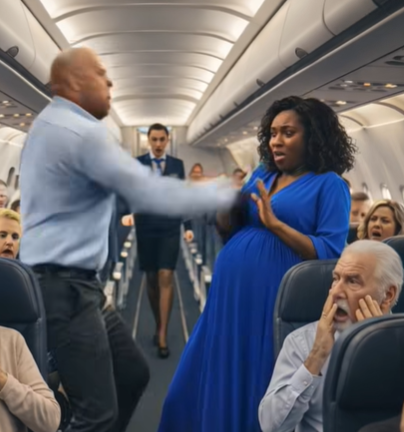
A racist man attacks a pregnant Black woman… then freezes when an FBI badge hits the floor
No one could have imagined that this flight would be turned upside down in a matter of seconds.
The first-class cabin was calm, almost routine. Passengers settled into their seats, stowed their bags, exchanged polite smiles. Among them sat Amara Jackson, seven months pregnant, quiet and composed,
one hand resting on her belly as she felt her baby’s gentle movements.
Then everything changed. A man, visibly irritated, suddenly lost control. His movement was fast, rough, and completely unexpected. Amara stumbled, barely steadying herself on the seat in front of her,
the air knocked from her lungs as she instinctively shielded her belly. Several passengers froze, stunned by what they had just seen. A heavy silence filled the cabin. — You should have moved when I told you to, the man snapped coldly. Amara felt it immediately—something was wrong. An unusual warmth. A sharp, creeping fear tightening in her chest.
She looked up at him. For the first time, his confidence faltered. The pain came in waves, growing harder to ignore. Her baby, so active moments ago,
suddenly went still. A flight attendant rushed over, worry written across her face. Whispers spread through the cabin. The man,
now seated where he had demanded, denied everything with unsettling calm, as if he had rehearsed this moment before. Too smooth.
Too confident. — I recorded everything, a teenage girl suddenly said, lifting her phone.
The tension thickened. Amara took a slow breath… then leaned down to retrieve a napkin that had fallen from her bag.
As she did, something slipped out. An FBI badge hit the floor. The man froze. His face went blank, as if time itself had stopped. What happened next left every passenger in shock…
A Racist Man Attacks a Pregnant Black Woman… Then Freezes When an FBI Badge Hits the Floor
Part One — The Badge
The badge struck the cabin floor with a sharp metallic sound.
For one impossible second, nobody moved.
Amara Jackson remained bent beside her seat, one hand gripping the armrest and the other instinctively protecting the curve of her seven-month pregnant belly.
The silver badge lay beneath the edge of the seat, its credentials facing upward.
The man who had attacked her stared at it.
His expression changed so quickly that the teenage girl with the phone noticed before anyone else did.
A moment earlier, he had been angry.
Then he had been smug.
Now he looked terrified.
“FBI?” someone whispered.
The flight attendant looked down.
Then she looked at Amara.
Then back at the badge.
Amara slowly straightened herself.
Her breathing was shallow.
Her face had gone pale.
But her voice was remarkably steady.
“Please,” she said quietly, “don’t touch it.”
The man immediately pulled his hand away.
“I wasn’t going to,” he said.
Nobody believed him.
The teenage girl lowered her phone for a moment.
“You know what that badge means?” she asked.
The man swallowed.
“I don’t know what you’re talking about.”
“You recognized it.”
“I said I don’t know what you’re talking about.”
Amara looked directly at him.
“Yes, you do.”
The cabin seemed to shrink around them.
Every passenger had become a witness.
Every whisper seemed louder than it should have been.
The flight attendant crouched carefully and looked at Amara.
“Ma’am, are you hurt?”
Amara hesitated.
“My stomach hurts.”
The attendant’s expression immediately changed.
“Is the baby moving?”
Amara placed both hands against her belly.
Nothing.
Her eyes closed.
She waited.
One second.
Two.
Five.
Ten.
Still nothing.
“My baby was moving before this happened,” she whispered.
The teenage girl stood up.
“Someone call for medical help.”
The flight attendant immediately reached for the cabin communication system.
The man suddenly spoke.
“I didn’t hit her.”
Amara looked at him.
“You shoved me.”
“I barely touched you.”
“You shoved me.”
“You were blocking the aisle.”
“I was standing beside my seat.”
“You should have moved.”
The words hung in the air.
A passenger near the window quietly said, “We all heard you.”
Another voice followed.
“I saw him push her.”
“So did I.”
“I recorded it.”
The man looked around.
For the first time, he seemed to understand something terrifying.
He wasn’t controlling the story anymore.
He had thought he was.
He had believed that because he was loud, confident, and physically intimidating, everyone would accept his version of events.
But now there were witnesses.
There was a recording.
There was a badge.
And there was a pregnant woman whose unborn child might have been affected by what he had done.
Then Amara felt something.
A tiny movement.
Her eyes widened.
“Oh.”
The flight attendant leaned closer.
“What?”
Amara pressed her palm against her stomach.
“There.”
She breathed out.
“My baby moved.”
A collective exhale passed through the cabin.
The teenage girl almost cried from relief.
“Thank God.”
Amara closed her eyes.
But the relief lasted only seconds.
Because when she opened them again, the man was no longer looking at her.
He was staring at the badge.
And Amara realized something.
He wasn’t simply afraid of the FBI.
He was afraid of being recognized.
Part Two — Who Was Amara Jackson?
Before that flight, almost nobody in the cabin knew Amara Jackson.
To them, she was simply a pregnant woman traveling alone.
She wore a dark blue blazer over a loose cream blouse.
Her hair was pulled back neatly.
A small leather bag rested beside her seat.
She had spent most of the flight reading a folder and occasionally looking out the window.
She had not wanted attention.
In fact, attention was the last thing she wanted.
Amara had been traveling because of work.
Her work was complicated.
Her work was sensitive.
And the badge on the floor was something she almost never carried openly.
She had been an FBI special agent for eight years.
She had investigated financial crimes, organized crime, corruption, and cases involving threats against federal employees.
She had learned early that the most dangerous people were not always the ones who shouted.
Sometimes they smiled.
Sometimes they wore expensive suits.
Sometimes they spoke softly while destroying people’s lives.
She had also learned that being underestimated could be an advantage.
Her colleagues sometimes joked that Amara could walk into a room looking like someone’s favorite schoolteacher and walk out with enough evidence to send three people to prison.
But pregnancy had changed how strangers looked at her.
Some people saw vulnerability.
Some saw inconvenience.
Some saw a woman who should have stayed home.
Amara saw something different.
She saw a life growing inside her.
She saw a future.
And she refused to become smaller because other people were uncomfortable with her existence.
The man across the aisle had noticed her before the incident.
His name was Grant Mercer.
He was forty-six years old.
He worked as a regional executive for a construction company.
He was wealthy.
He was accustomed to getting his way.
And according to several people who knew him, he had a temper that could turn a simple disagreement into a confrontation.
What most passengers did not know was that Grant had been nervous before he ever boarded the plane.
He had received a phone call that morning.
The caller had said only six words.
“They know about the missing money.”
Grant had spent the rest of the morning trying to convince himself that the message was meaningless.
Now, as he stared at the FBI badge, he understood that the coincidence was too perfect.
Amara had not been on this flight by accident.
Neither had he.
Part Three — The Girl With the Phone
The teenage girl stepped into the aisle.
“My name is Zoe.”
The flight attendant looked at her.
“Zoe, please return to your seat.”
“I recorded what happened.”
The girl held up her phone.
“I think you need to see it.”
The attendant glanced toward Amara.
Amara nodded.
“Let her show you.”
Zoe walked closer.
Her hands were trembling.
“I wasn’t trying to record him.”
“I was recording the cabin because my mom told me not to get bored.”
A few passengers gave nervous smiles.
Zoe continued.
“When he started arguing with her, I kept recording because he sounded angry.”
She looked at Grant.
“Then he pushed her.”
Grant’s face hardened.
“Delete that.”
Zoe immediately stepped backward.
“No.”
“You don’t understand.”
“I understand exactly what I recorded.”
“Give me the phone.”
“No.”
The man stood.
Several passengers immediately reacted.
“Stay back.”
“Sit down.”
“Don’t touch her.”
Grant stopped.
The flight attendant stepped between them.
“Sir, you need to remain seated.”
Grant looked at Amara.
“You set this up.”
Amara’s eyes narrowed.
“What?”
“You knew who I was.”
“No.”
“You knew I was on this flight.”
“I didn’t.”
“You’re lying.”
Amara looked at him for several seconds.
Then she said something that made his face change again.
“Grant Mercer.”
Silence.
The teenage girl’s mouth fell open.
“How does she know his name?”
Grant stared at Amara.
“You don’t know me.”
“I know enough.”
“How?”
“Because your name appeared in an investigation I worked on.”
The cabin erupted in whispers.
Grant’s confidence vanished.
The flight attendant looked at Amara.
“Ma’am, is this an official investigation?”
Amara reached toward her bag.
“Not exactly.”
She paused.
“Not yet.”
Grant whispered, “What does that mean?”
“It means I was traveling to meet someone connected to your company.”
Grant’s face became pale.
“Who?”
Amara didn’t answer.
Instead, she looked at the badge on the floor.
“That’s why you were frightened.”
Grant shook his head.
“You’re making a mistake.”
“No.”
“You have no idea what you’re talking about.”
“Then why did you recognize my badge?”
He said nothing.
And that silence told everyone more than an answer could have.
Part Four — The Medical Emergency
A voice came over the cabin communication system.
“Is there a doctor on board?”
Several passengers looked around.
A man near the rear raised his hand.
“I am.”
He hurried forward.
He introduced himself as Dr. Samuel Reed.
He had spent twenty years working in emergency medicine.
He immediately knelt beside Amara.
“Tell me where it hurts.”
“Lower abdomen.”
“Any bleeding?”
“No.”
“Dizziness?”
“A little.”
“Did you fall?”
“No.”
“Was there direct impact?”
“She was shoved,” Zoe said.
Dr. Reed looked at Amara.
“Do you feel the baby moving?”
“Yes.”
“Good.”
He carefully assessed her condition.
“We need to get you evaluated as soon as possible.”
The pilot was informed.
The flight attendant returned.
“We’re beginning an emergency diversion.”
Amara looked up.
“Where?”
“Nearest suitable airport.”
Grant suddenly spoke.
“No.”
Everyone turned.
The flight attendant frowned.
“Sir?”
“You can’t divert because of this.”
Dr. Reed stared at him.
“She’s pregnant and has abdominal pain after an assault.”
Grant shook his head.
“She said she’s fine.”
Dr. Reed’s voice became firm.
“That is not your decision.”
Grant looked at him.
“You don’t understand.”
“No,” the doctor replied.
“I understand perfectly.”
The cabin grew quiet again.
Amara looked at Grant.
“What are you afraid of?”
He didn’t answer.
She leaned back against the seat.
“You’re not afraid of being arrested.”
Grant’s jaw tightened.
“You’re afraid of what I’ll find if I look into you.”
Grant stared at her.
Then he whispered, “You don’t know what you’re getting into.”
Amara heard the words.
So did everyone else.
And suddenly the story was no longer about a man attacking a pregnant woman.
It was about something much bigger.
Part Five — The Secret in Row 3
The emergency diversion was announced.
Passengers were instructed to remain seated.
Flight attendants secured the cabin.
But the atmosphere had changed completely.
Nobody was sleeping anymore.
Nobody was pretending nothing had happened.
People watched Grant.
People watched Amara.
And Zoe kept her phone in her hand.
Grant sat motionless.
His face was covered in sweat.
He looked at the badge again.
Amara noticed.
“Why are you so afraid of me?”
Grant whispered, “I’m not.”
“You are.”
“You’re just an agent.”
Amara’s expression hardened.
“Just?”
Grant immediately regretted the word.
She looked away.
The doctor continued monitoring her.
After several minutes, the baby moved again.
Amara almost cried.
Not because she was afraid.
Because she had been holding her breath for too long.
She placed one hand over her belly.
“I’m here,” she whispered.
Dr. Reed heard her.
“Your baby hears you.”
She smiled faintly.
“My husband says the same thing.”
“Is he waiting for you?”
“No.”
The doctor noticed the sadness in her voice.
“He passed away?”
Amara shook her head.
“He’s deployed.”
Dr. Reed nodded.
“Military?”
“Yes.”
“Then you’ll have to tell him about today.”
Amara gave a quiet laugh.
“I think he’ll hear about it before I can tell him.”
Meanwhile, Zoe approached the flight attendant.
“There’s something else.”
“What?”
“My recording starts before the incident.”
The attendant looked concerned.
“What do you mean?”
“I heard him talking to someone.”
“Who?”
“I don’t know.”
Zoe played the recording.
A muffled male voice could be heard.
“You said she wouldn’t be here.”
Grant’s head snapped upward.
Zoe stopped the recording.
Everyone stared at him.
Amara said quietly, “Play it.”
The recording continued.
Another voice said, “She wasn’t supposed to be on this flight.”
Grant closed his eyes.
Amara’s expression changed.
Someone had expected her not to be there.
And that meant the attack might not have been spontaneous at all.
Part Six — The Man Who Knew Too Much
The recording continued.
“Do you have the file?”
“Yes.”
“Where?”
“Not with me.”
“Then why are you here?”
“I told you, I had no choice.”
The voices became muffled.
Then Grant’s voice became clear.
“If she finds out, we’re finished.”
Amara stared at him.
“Who is she?”
Grant said nothing.
“Who were you talking to?”
“I don’t know.”
“You’re lying.”
“I don’t know who that was.”
Zoe looked at Amara.
“There was one more thing.”
“What?”
“I heard him say your name.”
Amara’s face became still.
“When?”
“Before he came over.”
“What did he say?”
Zoe looked uncomfortable.
“He said, ‘Jackson can’t know.’”
Amara slowly turned toward Grant.
“Jackson?”
Grant swallowed.
“Yes.”
“You weren’t talking about a random person.”
“No.”
“You were talking about me.”
He looked away.
The cabin seemed to hold its breath.
Amara reached into her bag.
This time she removed a small notebook.
She opened it.
On the first page was a list of names.
Grant Mercer was one of them.
She had written his name three days earlier.
Beside it was a question.
Where did the money go?
Grant saw it.
His eyes widened.
“You already knew.”
“I suspected.”
“You’ve been investigating us.”
“Yes.”
“Then you knew what would happen.”
“No.”
Amara’s voice became cold.
“I expected evidence.”
“I didn’t expect an assault.”
Grant looked down.
“I didn’t mean to hurt you.”
“You pushed me.”
“I was angry.”
“You were racist.”
The word echoed through the cabin.
Grant looked away.
Several passengers stared at him.
Amara continued.
“You told me to move because you said people like me shouldn’t be sitting here.”
A passenger near the window spoke.
“He did.”
Another passenger nodded.
“I heard it.”
Grant closed his eyes.
For the first time, he looked ashamed.
But Amara wasn’t interested in shame.
She was interested in truth.
Part Seven — The Missing Money
The aircraft began its descent.
The pilot announced the emergency landing.
Grant’s hands were shaking.
Amara noticed.
“You stole something.”
Grant looked at her.
“No.”
“Money.”
“No.”
“Documents.”
“No.”
“Something from your company.”
Grant remained silent.
Amara waited.
Finally, he whispered, “I didn’t steal it.”
“Then who did?”
“My boss.”
“Who?”
“Elliot Vance.”
Amara’s eyes narrowed.
That name was not on her list.
“Where is he?”
“I don’t know.”
“That’s a lie.”
“He disappeared.”
“When?”
“Two days ago.”
“Why?”
“Because the money was discovered.”
“How much?”
Grant looked around the cabin.
“Twenty-eight million dollars.”
A stunned murmur spread through the seats.
Zoe whispered, “Twenty-eight million?”
Grant nodded.
“It was supposed to disappear slowly.”
“Into what?”
“Shell companies.”
“Whose?”
Grant said nothing.
Amara leaned closer.
“Whose?”
Grant finally looked at her.
“Federal contracts.”
The atmosphere changed instantly.
Amara understood.
This was not simply corporate theft.
If federal money had been diverted through shell companies, the case could involve fraud, bribery, conspiracy, and potentially national security concerns.
“What does this have to do with me?”
Grant’s voice became barely audible.
“Your name appeared in the documents.”
Amara froze.
“My name?”
“Yes.”
“Why?”
“I don’t know.”
“Tell me.”
“I swear.”
“Tell me what you know.”
Grant took a breath.
“Someone inside the government was helping them.”
Amara stared at him.
“Who?”
“I don’t know.”
“Then why did they mention my name?”
“Because they were afraid you would find it.”
“Find what?”
Grant looked toward the cabin door.
“The real ledger.”
Part Eight — The Real Ledger
The aircraft touched down.
Emergency vehicles waited outside.
The doors opened.
Medical personnel rushed aboard.
Amara was carefully escorted from the aircraft.
She kept one hand over her belly.
The other held her bag.
But before she left, she looked back at Grant.
“Don’t move.”
Grant laughed nervously.
“Where am I going?”
“You’d be surprised.”
Two federal agents entered the aircraft.
They recognized Amara immediately.
“Agent Jackson.”
She nodded.
“Get the man who assaulted me secured.”
One agent looked at Grant.
“Mr. Mercer, stand up.”
Grant stood.
His face had become expressionless.
As the agents escorted him away, he suddenly stopped.
“Agent Jackson.”
She turned.
“What?”
“There was another person on the flight.”
“What?”
“He’s sitting in the back.”
Amara looked toward the rear cabin.
“Who?”
Grant pointed.
“Third row from the back.”
Everyone turned.
A middle-aged man wearing glasses looked up.
He seemed confused.
“Me?”
Grant nodded.
“He’s the one who gave me the instructions.”
The man’s face changed.
He stood.
“I don’t know this man.”
The federal agent immediately blocked the aisle.
“Sir, sit down.”
The man sat.
Amara stared at him.
Something about his face seemed familiar.
Then she remembered.
She had seen him once before.
Not in person.
In a photograph.
He had been standing behind a senator during a congressional hearing.
Her stomach tightened.
“What’s your name?”
The man swallowed.
“Daniel Whitmore.”
Amara’s eyes narrowed.
“Daniel Whitmore.”
“Yes.”
“Senior counsel for Senator Bell?”
The man’s silence was answer enough.
The entire investigation had just changed.
Part Nine — The Hospital
Hours later, Amara lay in a hospital bed.
The baby was healthy.
The doctors wanted to monitor her overnight.
Her husband finally called.
“Amara?”
She smiled when she heard his voice.
“I’m okay.”
“You don’t sound okay.”
“I’m tired.”
“What happened?”
She hesitated.
“A man attacked me on the flight.”
Silence.
Then her husband’s voice became very quiet.
“Are you and the baby safe?”
“Yes.”
“Are you sure?”
“Yes.”
“I’ll come home.”
“No.”
“I said I’ll come home.”
“And I said no.”
“Amara.”
“You have a mission.”
“You are my family.”
“And this is your country too.”
He exhaled.
“You always do that.”
“Do what?”
“Make me feel like arguing with you is impossible.”
She laughed softly.
“I love you.”
“I love you too.”
Then his voice changed.
“Who attacked you?”
Amara looked toward the hospital window.
“His name is Grant Mercer.”
“Does that name mean something?”
“Maybe.”
“Amara.”
“I’ll explain when you’re home.”
“You promise?”
“I promise.”
After the call ended, Amara stared at the ceiling.
She had spent years learning how to remain calm under pressure.
But now she was alone in a hospital room with a question she couldn’t ignore.
Why had someone gone to such lengths to make sure she never saw the real ledger?
Part Ten — The Second Twist
At 2:13 in the morning, Amara received a message.
Unknown number.
Stop investigating.
She stared at the screen.
A second message appeared.
Your baby is not safe.
Her heart stopped.
She immediately sat upright.
Then another message arrived.
You should have stayed off that plane.
Amara called the number.
It was disconnected.
She contacted the agents assigned to the case.
Within minutes, security was placed outside her room.
But the messages continued.
We know where your husband is.
Then one final message.
Ask Grant Mercer what happened in Warehouse 17.
Amara stared at the words.
Warehouse 17.
She knew that location.
It was listed in one of the investigation files.
But it had never been connected to Grant.
Until now.
She called the lead investigator.
“We need to go back.”
“Where?”
“Warehouse 17.”
“Agent Jackson, you’re in a hospital.”
“I know.”
“You’ve just been assaulted.”
“I know.”
“You need rest.”
Amara looked at the messages.
“No.”
Her voice became firm.
“We need answers.”
Part Eleven — Warehouse 17
The following morning, investigators entered Warehouse 17.
The building had been abandoned for months.
Dust covered the floor.
Old shipping containers stood against the walls.
Amara remained outside under medical supervision.
She watched the agents search the interior.
Then one agent shouted.
“We found something.”
A hidden room had been discovered behind a false wall.
Inside were boxes of financial records.
Photographs.
Encrypted drives.
And one locked metal case.
The case contained a ledger.
Not a digital file.
Not a spreadsheet.
A handwritten ledger.
Names.
Dates.
Amounts.
Initials.
And beside one entry was a note.
Jackson knows too much.
Amara stared at it.
Then she saw the signature beneath the note.
Daniel Whitmore.
The man from the airplane.
But the biggest shock was still waiting.
One page contained a list of federal employees.
Amara’s name was there.
So was her husband’s.
And beneath both names was a single word.
Leverage.
Amara’s face went cold.
This wasn’t about stopping an investigation anymore.
It was about controlling people.
And someone had decided that her unborn child could become part of the threat.
Part Twelve — The Confrontation
Grant Mercer eventually agreed to speak.
He sat across from Amara in an interview room.
For the first time, he looked exhausted.
“You attacked me because you were afraid.”
“Yes.”
“You knew I was investigating.”
“Yes.”
“You knew about the ledger.”
“Yes.”
“You knew about Daniel Whitmore.”
“Yes.”
Amara leaned forward.
“Then tell me everything.”
Grant stared at the table.
“I joined the company because I wanted money.”
“That isn’t unusual.”
“I wanted status.”
“That isn’t unusual either.”
“I thought I could control things.”
“And?”
“I couldn’t.”
He looked up.
“People above me were making decisions I didn’t understand.”
“When did you realize?”
“When I saw the first body.”
Amara went still.
“Whose body?”
“I don’t know his name.”
“Where?”
“Warehouse 17.”
“What happened?”
“He had discovered the money.”
“Who killed him?”
Grant shook his head.
“I didn’t see.”
“Then why stay?”
“Because they threatened my family.”
Amara’s expression softened slightly.
“Did you ever try to leave?”
“Yes.”
“What happened?”
“They sent me a photograph.”
“Of your family?”
Grant nodded.
“I knew then that there was no leaving.”
Amara was silent.
“You attacked me because they ordered you to?”
“No.”
“Then why?”
Grant looked ashamed.
“Because I was angry.”
“At me?”
“At everything.”
He looked down.
“And because I thought if I scared you enough, you would leave.”
Amara studied him.
“You chose the wrong woman.”
Grant almost smiled.
“I know.”
Part Thirteen — The Betrayal
The investigation expanded.
Daniel Whitmore was arrested.
Elliot Vance was found hiding outside the country.
The shell companies were traced.
The money trail reached powerful people.
But one question remained.
Who had ordered the threats against Amara?
The answer came from an encrypted drive.
The person behind the operation wasn’t Daniel.
It wasn’t Grant.
It wasn’t Elliot.
It was someone much closer to the investigation.
Someone who had access to federal information.
Someone who knew exactly when Amara would travel.
Someone who knew her husband’s deployment schedule.
Someone who knew she was pregnant.
The name appeared on the screen.
Agent Thomas Keller.
Amara stared at it.
Keller had been her mentor.
He had taught her how to investigate corruption.
He had stood beside her during her first major case.
He had attended her wedding.
He had sent flowers when she announced her pregnancy.
He had told her she was like a daughter to him.
Now his name was sitting inside the evidence.
Amara whispered, “No.”
The lead investigator looked at her.
“You know him.”
“Yes.”
“Trust him?”
She stared at the screen.
“I did.”
“That isn’t what I asked.”
Amara took a long breath.
“No.”
Part Fourteen — The Man Behind the Curtain
Keller was confronted in his office.
He didn’t run.
He didn’t deny anything.
He simply looked at Amara.
“You found it.”
“Yes.”
“I knew you would.”
“Why?”
“Because you’re good.”
“You used my family.”
“I protected the operation.”
“You threatened my baby.”
“I never ordered anyone to hurt your child.”
“You put my name on a leverage list.”
“To keep you away.”
“You sent Grant.”
“No.”
“He attacked me because he was afraid.”
Keller looked away.
“I lost control of the situation.”
“You lost control?”
“Yes.”
“You built an entire conspiracy and you’re calling this a loss of control?”
Keller finally looked at her.
“You don’t understand what was at stake.”
“Then explain it.”
“The people behind this network had access to classified information.”
“And you joined them.”
“I infiltrated them.”
Amara froze.
“What?”
Keller continued.
“I was undercover.”
“Then why hide the evidence?”
“Because I needed proof.”
“You could have told me.”
“I couldn’t.”
“Why?”
“Because someone inside the Bureau was watching you.”
Amara’s eyes narrowed.
“Who?”
Keller shook his head.
“I don’t know.”
“Then why did you manipulate the investigation?”
“Because I believed the only way to expose the network was to let them think they were winning.”
Amara stared at him.
“You put me in danger.”
“Yes.”
“And you knew I was pregnant.”
“Yes.”
“You let them come after me.”
Keller’s eyes filled with regret.
“I made a terrible calculation.”
Amara’s voice became cold.
“You don’t get to call my life a calculation.”
Keller looked down.
“No.”
“You don’t get to decide that my child is an acceptable risk.”
“No.”
“And you don’t get to hide behind the word ‘undercover’ after everything you did.”
He nodded.
“I know.”
The room became silent.
Then Amara said the sentence that ended their relationship forever.
“You taught me to trust evidence.”
She pointed at him.
“And the evidence says I can never trust you again.”
Part Fifteen — The Trial
Months later, the courtroom was packed.
Grant Mercer sat at the defense table.
Daniel Whitmore sat several seats away.
Elliot Vance was present under heavy security.
Keller sat separately.
The government presented evidence.
Financial records.
Phone recordings.
Security footage.
The airplane video.
And Zoe’s recording.
When the courtroom heard Grant’s voice telling Amara that she should have moved, several people looked toward him.
Grant lowered his head.
When the footage showed him pushing her, the courtroom became silent.
But the most powerful testimony came from Amara.
She walked to the witness stand.
She looked directly at the jury.
“I was seven months pregnant.”
She paused.
“I was afraid.”
Another pause.
“But fear did not make me powerless.”
She described the attack.
She described the badge falling.
She described Grant’s expression.
Then she spoke about something deeper.
“The badge didn’t make me important.”
The courtroom was completely silent.
“It didn’t make me more worthy of respect.”
She looked at the jury.
“And it didn’t make what happened to me wrong.”
Her voice became stronger.
“What made it wrong was that a man decided another human being deserved less dignity because of the color of her skin.”
Grant looked down.
Amara continued.
“I want people to understand something.”
“You don’t need a badge to deserve safety.”
“You don’t need authority to deserve respect.”
“You don’t need power to deserve to be treated like a human being.”
Her words remained in the courtroom long after she stepped down.
Part Sixteen — Zoe
After the trial, Amara searched for Zoe.
The teenager had become an unexpected part of the case.
Her recording had helped investigators establish the truth.
But Amara didn’t want to thank her with a simple letter.
She wanted to meet her.
They sat together at a small café.
Zoe looked nervous.
“I still can’t believe all that happened.”
Amara smiled.
“Neither can I.”
“I almost didn’t record it.”
“Why did you?”
Zoe shrugged.
“I don’t know.”
“Yes, you do.”
Zoe smiled.
“I guess I thought someone should know the truth.”
Amara nodded.
“That is courage.”
Zoe looked down.
“Did I really help?”
“You did.”
“Like, actually?”
“Actually.”
Zoe smiled.
Then she asked the question she had been afraid to ask.
“Is your baby okay?”
Amara smiled.
“Yes.”
“Boy or girl?”
“Girl.”
Zoe’s face lit up.
“What’s her name?”
Amara touched her belly.
“Grace.”
Zoe smiled.
“That is beautiful.”
“Because of what happened?”
Amara shook her head.
“No.”
She smiled.
“Because grace is what you show when someone gives you every reason not to.”
Part Seventeen — The Baby
Three months later, Amara gave birth.
Her husband was home.
Her mother was there.
Zoe was not there.
But Amara had saved something for her.
A photograph.
A tiny baby wrapped in a white blanket.
The note beneath it said:
You helped protect her before you ever met her.
Zoe cried when she received it.
Amara cried too.
But the story didn’t end with the arrests.
Because justice was never simply about putting people behind bars.
It was about what happened afterward.
Grant Mercer eventually accepted responsibility for his actions.
He publicly apologized.
Not because an apology erased what he had done.
It didn’t.
But because he finally understood that accountability required more than excuses.
He had spent years believing that power meant being feared.
He eventually learned that power without responsibility was simply another form of weakness.
Daniel Whitmore cooperated with investigators.
Elliot Vance was convicted on multiple federal charges.
Keller’s undercover operation was examined independently.
Some investigators believed his intentions had been legitimate.
Others believed he had crossed ethical boundaries that could never be justified.
Amara remained conflicted.
She never forgave him.
But she eventually stopped allowing anger toward him to occupy space in her life.
She had a daughter to raise.
A husband to love.
And a future to build.
Part Eighteen — Five Years Later
Five years passed.
Grace was five years old.
She loved books.
She loved butterflies.
And she asked far too many questions.
One afternoon, she found the old FBI badge inside a box.
“Mommy?”
Amara looked up.
“What?”
“What is this?”
Amara walked over.
She knelt beside her daughter.
“That belonged to Mommy.”
“Were you a superhero?”
Amara laughed.
“No.”
“Then why do you have a badge?”
“Because Mommy had a job.”
“What job?”
“A job where I helped people.”
Grace considered this.
“Did the badge help you?”
Amara looked at it.
Then she smiled.
“Not really.”
Grace frowned.
“Why?”
“Because the badge was just metal.”
She tapped her daughter’s chest gently.
“The important part was always here.”
Grace smiled.
“In my heart?”
“In your heart.”
Then Grace hugged her.
Amara closed her eyes.
For a moment, she remembered the airplane.
The shove.
The fear.
The silence.
The badge hitting the floor.
And the moment when an entire cabin realized that the person they had underestimated was not powerless.
But she also remembered something else.
A teenage girl standing up.
A doctor kneeling beside her.
Passengers refusing to stay silent.
A husband answering the phone.
People choosing courage when fear would have been easier.
That was the real story.
Not the badge.
Not the FBI.
Not the courtroom.
Not even the man who attacked her.
It was the people who decided that cruelty would not be allowed to become normal.
Part Nineteen — The Last Conversation
Years later, Amara received one final letter.
It was from Grant.
She almost threw it away.
Instead, she opened it.
There was no excuse inside.
No request for forgiveness.
No attempt to explain.
Only a few pages describing what prison had taught him.
He wrote that he had spent most of his life believing people were divided into categories.
People who mattered.
People who didn’t.
People who deserved opportunities.
People who didn’t.
He wrote that he had been wrong.
He wrote that the moment the badge fell to the floor had frightened him.
But not because Amara was powerful.
Because for the first time, he had seen the person behind his prejudice.
A woman.
A mother.
A professional.
A human being.
He wrote:
“I spent years believing fear was strength.”
“I finally learned that fear is what weakness looks like when it has nowhere left to hide.”
Amara folded the letter.
She did not forgive him.
Not that day.
Maybe not ever.
But she no longer needed him to understand her worth.
She already knew it.
Part Twenty — The Badge Hits the Floor
Years after the flight, Amara returned to the same airport.
She was traveling with Grace.
Her daughter held her hand.
“Mommy, are we going on another airplane?”
“Yes.”
“Are you scared?”
Amara smiled.
“Not today.”
They walked through the terminal.
Grace suddenly looked up.
“Mommy?”
“Yes?”
“What’s the bravest thing you’ve ever done?”
Amara stopped.
She thought about the question.
She could have mentioned investigations.
She could have mentioned dangerous arrests.
She could have mentioned the cases that had put her life at risk.
Instead, she said:
“Staying kind when someone gave me every reason to become bitter.”
Grace didn’t completely understand.
But she smiled anyway.
They continued walking.
And behind them, the airport remained exactly what it had always been.
People arriving.
People leaving.
Strangers crossing paths without knowing how dramatically their lives might change.
Amara looked down at her daughter.
Grace squeezed her hand.
And Amara realized something.
The most important moment on that airplane had never been when the badge fell.
It was what happened after.
A stranger chose to record.
A doctor chose to help.
Passengers chose to speak.
A frightened woman chose not to surrender.
And a little girl who had not yet been born became a reminder that the future is always worth protecting.
The badge had hit the floor.
But courage had risen.
And that was the ending Amara carried with her.
Not revenge.
Not hatred.
Not fear.
Just the quiet knowledge that sometimes the most powerful person in the room is not the one who shouts the loudest.
Sometimes it is the person who stands back up.
And keeps walking.