
US First Lady Melania Trump’s official White House portrait was released earlier today, January 28, 2025, on her Facebook page. Experts have offered their perspectives on the subtleties of the eye-catching, hotly debated image, setting the scene for what it symbolizes
The Washington Monument can be seen behind her through the White House’s opulent windows, and its existence quietly adds to the moment’s historical significance. Her face was softly glowing from the natural light coming through the window, which emphasized the contrast between her dark outfit and the bright background.
Online debates broke out following the release of the White House photograph, with internet users voicing a variety of viewpoints.
One person wrote, “Those eyes……….!!!” in response to her eyes, while another user said, “Wow! I can tell she is serious by the look in her eyes.
Others took a more critical approach to voicing their thoughts, pointing out what they believed to be a harsh expression. “Yikes she looks so mean!” opined one person. Similarly, someone else said, “That look on her Face…if [sic] looks could k*ll.”A striking similarity between Melania and her husband, US President Donald Trump, was also mentioned by numerous internet users. An onlooker remarked, “I swear she’s looking more and more like her husband,”
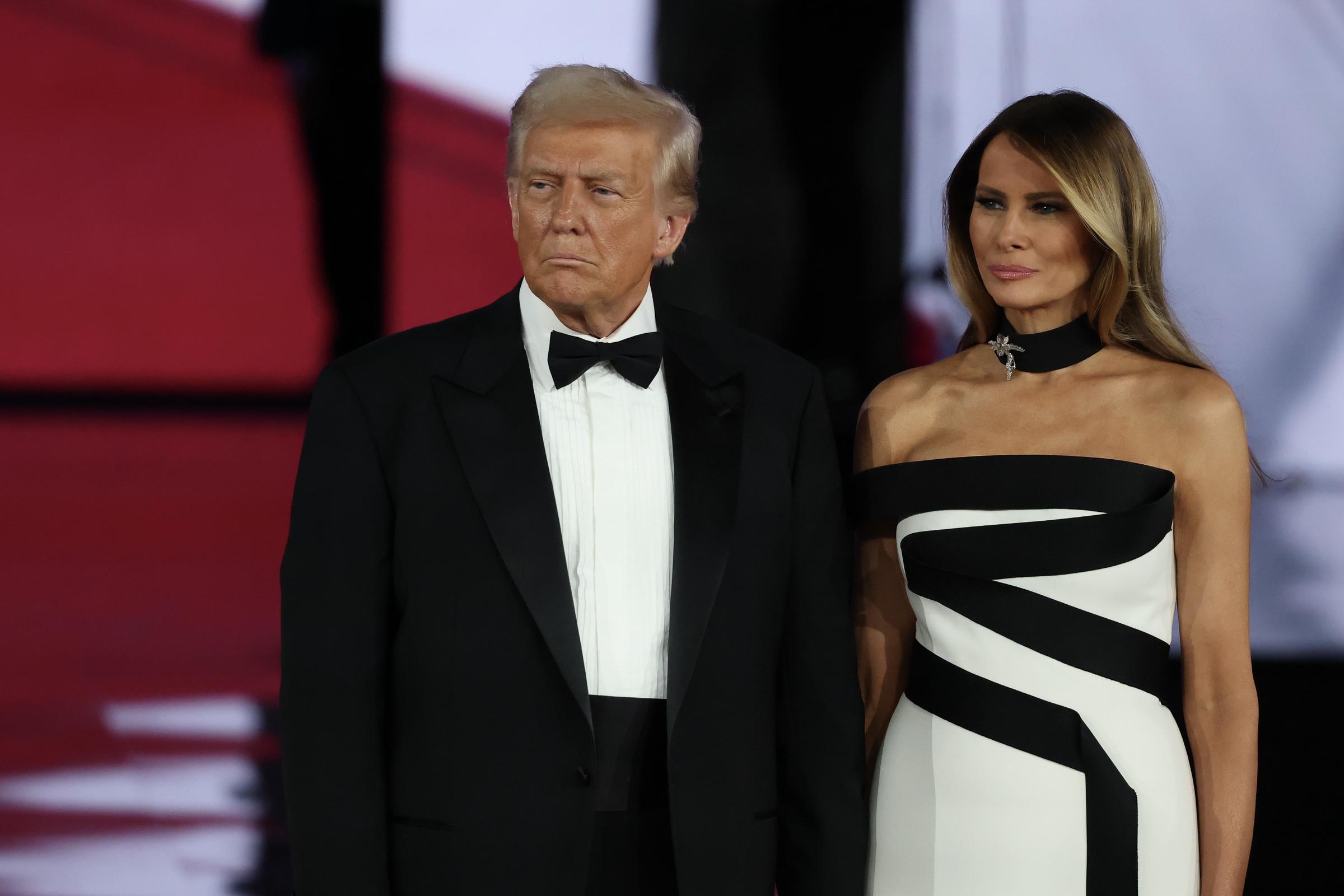
The Portrait That Started a Conversation: What Melania Trump’s White House Image Came to Symbolize
The photograph had been published.
The reactions had already begun.
But what happened next was about more than whether people liked Melania Trump’s expression.
Within hours, the portrait became a strange kind of mirror, reflecting whatever viewers already believed about the woman standing inside the White House.
Some saw confidence.
Some saw distance.
Some saw determination.
Others saw something colder.
And somewhere between those interpretations was the question that lingered beneath almost every comment:
What was Melania Trump actually trying to say without saying a word?
That question would prove much harder to answer than anyone expected.
Because official portraits are rarely just photographs.
They are carefully constructed images in which clothing, posture, lighting, architecture, expression, and even the direction of a person’s gaze can become part of the message.
Melania Trump’s portrait immediately invited that kind of examination.
The dark suit created a sharp contrast against the brighter background.
The White House setting established the unmistakable political context.
And beyond the window, the Washington Monument quietly connected the image to the history of the capital itself.
Nothing about the composition felt accidental.
Yet the most powerful element was the one that could not be measured with a camera.
It was her expression.
For some viewers, the expression looked serious.
For others, it appeared almost intimidating.
And for still others, it seemed simply controlled.
That difference in perception became the real story.
Because two people could stare at the same photograph and walk away with completely different impressions.
One person could see strength where another saw severity.
One could see composure where another saw emotional distance.
One could see elegance where another saw calculation.
And that is precisely what made the portrait so fascinating.
It did not tell viewers what to think.
It gave them enough ambiguity to make them decide for themselves.
PART ONE — THE MOMENT BEFORE THE COMMENTS
Imagine the moment immediately before the photograph appeared online.
There was no comment section yet.
No arguments.
No memes.
No people zooming in on the eyes.
No comparisons.
No strangers attempting to decode an expression belonging to someone they had never met.
There was simply an image waiting to be seen.
And then it appeared.
Almost instantly, the photograph stopped belonging only to the person inside it.
It became public property in the cultural sense.
Millions of people could look at it.
Millions could interpret it.
Millions could attach their own experiences to it.
That is the strange power of a portrait connected to politics.
The subject may be one person.
The audience is everyone.
The first wave of reactions focused heavily on her eyes.
One commenter wrote, “Those eyes……….!!!”
Another described the expression as serious.
Someone else thought the look was harsh.
Another compared her appearance increasingly to her husband.
None of these comments could establish what Melania herself felt.
But collectively, they revealed something about how quickly audiences turn photographs into stories.
The photograph was static.
The interpretation was moving.
And the more people talked about it, the more dramatic the story became.
PART TWO — WHY THE EYES BECAME THE CENTER OF ATTENTION
Eyes are among the most scrutinized features in portrait photography because people instinctively search them for emotion.
We look for happiness.
We look for sadness.
We look for fear.
We look for confidence.
We look for uncertainty.
We look for sincerity.
And when a photograph gives us very little else to interpret, the eyes can become the entire conversation.
That appears to be what happened here.
Melania’s gaze became the focal point for viewers who wanted to determine the mood of the photograph.
But there was a problem.
A photograph captures a fraction of a second.
It does not provide the thoughts that existed before that second.
It does not provide the conversation that happened afterward.
It cannot explain what the person was thinking.
It cannot tell us whether someone was tired, focused, reflective, uncomfortable, confident, or simply concentrating on remaining still for the camera.
The human brain nevertheless wants an answer.
So it creates one.
That is why one person can look at the portrait and say, “She looks powerful.”
Another can look at exactly the same image and say, “She looks angry.”
Both people are looking at the same face.
They are simply bringing different expectations to it.
And this is where the portrait became far more interesting than an ordinary photograph.
It became a psychological Rorschach test of sorts.
People were not merely describing Melania.
They were revealing what they believed about Melania.
PART THREE — THE DARK SUIT
Then there was the clothing.
The dark outfit immediately established a visual seriousness.
Against the brighter interior and daylight beyond the window, the clothing became one of the strongest shapes in the frame.
It gave the photograph structure.
It also contributed to the perception of authority.
Clothing has always played an important role in political photography.
Presidents, first ladies, diplomats, royals, business leaders, and public figures have long understood that appearance communicates before words do.
A bright color can suggest openness.
A softer silhouette can suggest approachability.
A structured suit can suggest authority.
A monochromatic look can suggest restraint.
None of those interpretations are absolute.
But visual language works precisely because people have learned to associate certain choices with certain ideas.
In this portrait, the darker clothing allowed the face to remain the central human element.
The eye was naturally pulled toward the face.
Then the gaze moved outward.
The window appeared.
The Washington Monument emerged beyond it.
And suddenly the photograph expanded from an individual portrait into a picture of place.
PART FOUR — THE MONUMENT IN THE DISTANCE
The Washington Monument was not the main subject.
It did not need to be.
Its presence worked more quietly.
It reminded viewers that the photograph was not taking place in an ordinary room.
The setting was the White House.
Beyond the window was Washington.
Beyond Washington was the history represented by the capital.
And beyond that was the complicated machinery of American politics.
That visual connection gave the portrait an almost theatrical quality.
A woman stood in the foreground.
The seat of executive power surrounded her.
And one of the country’s most recognizable monuments appeared in the distance.
It was difficult not to read meaning into that arrangement.
But perhaps the most important thing was that the monument did not overpower her.
It remained in the background.
That choice kept the portrait centered on the individual.
The message, intentionally or otherwise, was not simply about the office.
It was also about the woman occupying a highly visible role within it.
PART FIVE — THE QUESTION EVERYONE WANTED ANSWERED
As reactions accumulated, another question began to emerge.
Was the expression intentional?
That question sounds simple.
It is not.
Professional portraits involve preparation.
The subject knows where the camera is.
The photographer knows what composition is being created.
Lighting is arranged.
Positioning is considered.
Clothing is selected.
Backgrounds are chosen.
Expressions may be adjusted.
The final photograph is rarely an accidental snapshot.
Yet that does not mean every detail carries a secret message.
Sometimes a serious expression is simply a serious expression.
Sometimes a person is concentrating.
Sometimes the photographer wants a formal image.
Sometimes the subject wants to project dignity rather than warmth.
And sometimes the audience simply sees what it expects to see.
That uncertainty became one of the reasons the image generated such strong reactions.
If the portrait had shown an unmistakably cheerful smile, there would have been less room for debate.
But the restrained expression created space for interpretation.
And the internet rushed into that space.
PART SIX — WHEN A PORTRAIT BECOMES A PERSONALITY TEST
There is an old habit in public life of treating photographs as evidence of personality.
A politician smiles, and people call them friendly.
A politician frowns, and people call them angry.
A celebrity looks away, and people assume discomfort.
A public figure appears relaxed, and people assume confidence.
But photographs are not personality tests.
They are moments.
The distinction matters.
Melania Trump has spent years living under unusually intense visual scrutiny.
Her clothes have been analyzed.
Her expressions have been analyzed.
Her gestures have been analyzed.
Her public appearances have been analyzed.
Even moments that might have passed unnoticed for an ordinary person can become headlines when they involve someone in the White House.
That creates a strange environment in which silence can become louder than speech.
A smile can become a story.
A frown can become a story.
A glance can become a story.
And sometimes an entire narrative can be constructed around a single frame.
PART SEVEN — THE COMPARISON THAT KEPT RETURNING
Among the comments, one comparison appeared repeatedly.
People said she was beginning to look more like her husband.
At first glance, the observation might seem superficial.
But beneath it was another fascinating question.
Why do audiences search for resemblance between spouses?
Part of the answer is familiarity.
Humans naturally notice patterns.
When two people spend years together, viewers may begin noticing similarities in expressions, posture, gestures, and even styling.
Political couples are particularly susceptible to this because they are photographed together so often.
Every appearance adds another visual reference.
Over time, the public develops a mental picture of the couple as a unit.
Then, when one partner appears alone, viewers compare that image with the established picture in their minds.
In this case, some viewers believed they detected similarities between Melania and Donald Trump.
But resemblance is subjective.
Lighting changes faces.
Camera angles change faces.
Makeup changes faces.
Expressions change faces.
And age naturally changes faces.
The same person can appear remarkably different from one photograph to another.
That makes internet comparisons entertaining to some viewers, but hardly definitive.
Still, the comments revealed something important.
The audience was not seeing the portrait in isolation.
They were seeing it through years of photographs.
PART EIGHT — BEHIND THE FORMALITY
There is another side to official portraits that viewers rarely see.
The waiting.
The preparation.
The repeated adjustments.
The photographer’s instructions.
The quiet moments between exposures.
The decision about where the subject should stand.
The question of how much background should be visible.
The balance between personal identity and institutional symbolism.
All of that disappears once the final image is released.
The public sees one frame.
The process behind that frame remains invisible.
That invisibility can make the final portrait appear more mysterious than it really is.
A person standing silently in a room may look as though they are deliberately communicating something profound.
But perhaps they were simply following instructions.
Perhaps the goal was formality.
Perhaps the goal was timelessness.
Perhaps the goal was to create a portrait that would still look appropriate years later.
That last possibility is especially important.
Official portraits are not designed only for the day they are released.
They become historical records.
They may hang in institutions.
They may appear in archives.
They may be reproduced in books.
They may be viewed decades later by people who never experienced the political moment in which they were created.
That changes the meaning of the image.
PART NINE — THE COMMENTS TURN INTO A CULTURAL DEBATE
As more people reacted, the conversation began moving beyond the photograph itself.
People started debating what a first lady should look like.
Should she appear warm?
Should she appear serious?
Should she smile?
Should she project authority?
Should an official portrait feel personal or institutional?
These questions have no universal answer.
Every first lady has approached public presentation differently.
Some have leaned heavily into warmth and accessibility.
Others have embraced formality.
Some portraits have emphasized personality.
Others have emphasized office.
Melania’s image immediately found itself in that larger tradition.
Viewers were not only judging a photograph.
They were comparing it with decades of expectations.
That comparison can be unfair.
Every era creates its own standards.
Every administration has its own political atmosphere.
Every public figure has a different personality.
Yet the audience still wants continuity.
It wants to understand a new image by comparing it with familiar ones.
That is how visual history works.
We remember what came before.
Then we decide what feels different.
PART TEN — THE WOMAN BEHIND THE IMAGE
The most difficult part of the entire discussion was separating the public image from the private person.
Melania Trump is a public figure.
But a portrait cannot reveal everything about the person it depicts.
It cannot show what she says at home.
It cannot reveal every private concern.
It cannot explain every decision.
It cannot tell viewers what she thinks when cameras are gone.
That boundary is important.
Public life encourages people to believe they know celebrities and political figures intimately.
Yet what audiences actually know is often a carefully limited collection of public moments.
The portrait belongs to that public collection.
It tells us something about presentation.
It does not tell us everything about the person.
And perhaps that is why the image generated such intense curiosity.
The less the photograph explained, the more people attempted to explain it themselves.
PART ELEVEN — A QUIET CHANGE IN THE CONVERSATION
Eventually, the initial shock of the image began to fade.
The most dramatic comments had already been made.
The jokes had appeared.
The compliments had appeared.
The criticism had appeared.
The comparisons had appeared.
But beneath all of that noise, a quieter conversation began.
People started asking whether the photograph would age well.
Would the serious expression still feel striking years from now?
Would the Washington Monument remain the detail people remembered?
Would the clothing become associated with the political era?
Or would the image eventually become simply another official portrait hanging among many others?
That is the strange fate of political photography.
At first, every detail feels important.
Years later, only certain details survive in public memory.
A photograph that once generated thousands of arguments can eventually become a historical artifact.
The people who argued about it may forget what they said.
But the image remains.
PART TWELVE — WHAT HISTORY DOES TO PHOTOGRAPHS
History has a habit of changing the meaning of pictures.
A photograph can look ordinary when it is taken.
Then something happens.
A presidency ends.
A political movement changes.
A major event occurs.
A public figure’s life takes an unexpected turn.
Suddenly an old photograph feels different.
The image itself has not changed.
The context around it has changed.
That is why official portraits matter.
They freeze a particular moment in time.
They say:
This was how this person was presented during this chapter of history.
They do not necessarily tell us whether the presentation was perfect.
They simply preserve it.
And that preservation can become more valuable with time.
PART THIRTEEN — THE COMMENT THAT MADE PEOPLE STOP
Among the thousands of reactions, the most memorable ones were not necessarily the harshest.
Sometimes the simplest comments created the strongest pause.
“Wow.”
“I can tell she is serious.”
“Those eyes.”
“She looks so mean.”
“She looks more like her husband.”
Five different reactions.
Five different interpretations.
Five different emotional responses to one photograph.
That was the real phenomenon.
The portrait had become a conversation because people could not agree on what they were seeing.
And disagreement is often what keeps an image alive.
A universally admired photograph may receive praise and disappear.
A universally disliked photograph may be mocked and disappear.
But a photograph that divides people can continue circulating.
Every new viewer becomes another participant.
Every new opinion gives the image another life.
PART FOURTEEN — WHY THE CONTROVERSY MATTERED
The controversy did not necessarily mean the portrait had failed.
In fact, controversy can indicate that an image has succeeded in attracting attention.
An official portrait that nobody notices accomplishes very little beyond documentation.
A portrait that makes people stop, look, discuss, argue, compare, and reconsider has entered public consciousness.
That does not mean every reaction is fair.
It does not mean every interpretation is accurate.
It simply means the image became culturally visible.
And visibility is powerful.
The portrait had moved from a White House release into social media conversations.
From social media conversations into commentary.
From commentary into broader debates about public image.
That progression is increasingly common in modern political life.
A photograph no longer stays where it is first published.
It travels.
It is cropped.
It is reposted.
It is discussed.
It is turned into a reaction image.
It becomes part of a larger digital archive.
And once that happens, controlling the meaning becomes almost impossible.
PART FIFTEEN — THE THING PEOPLE COULD NOT SEE
Perhaps the most fascinating element of the portrait was not visible at all.
It was the uncertainty.
Viewers could see the expression.
They could see the clothing.
They could see the room.
They could see the monument.
But they could not see the thoughts behind the eyes.
They could not hear the conversation surrounding the photograph.
They could not know what happened immediately before the shutter clicked.
They could not know what Melania thought when she first saw the final image.
And that missing information created the mystery.
The internet dislikes unanswered questions.
So it fills them.
Sometimes it fills them with humor.
Sometimes with criticism.
Sometimes with admiration.
Sometimes with speculation.
But the unanswered question remains:
What does the person in the photograph actually feel?
Only the person knows.
PART SIXTEEN — A PORTRAIT IS NOT A CONFESSION
That distinction deserves repeating.
A portrait is not a confession.
A serious face is not necessarily anger.
A confident gaze is not necessarily hostility.
A composed expression is not necessarily emotional distance.
And a photograph cannot provide access to a person’s private thoughts.
That does not make interpretation meaningless.
Art, photography, and political imagery have always invited interpretation.
But interpretation should remain interpretation.
It should not automatically become fact.
The internet moves quickly.
History moves slowly.
And sometimes the distance between those two speeds is where misunderstandings begin.
PART SEVENTEEN — THE IMAGE THAT WILL REMAIN
Long after the comments disappear, the photograph will remain.
People who were arguing online may eventually forget the exact words they used.
New generations may encounter the portrait without knowing the original controversy.
They may see only a woman standing in an important room.
They may notice the Washington Monument.
They may notice the dark clothing.
They may notice the expression.
They may wonder why the photograph became so widely discussed.
And perhaps that is when the image will gain its most interesting meaning.
Because history has a way of stripping away the noise.
The memes disappear.
The arguments become footnotes.
The outrage fades.
The compliments fade too.
What remains is the photograph.
And the photograph becomes a record.
PART EIGHTEEN — THE LAST LOOK
There is something almost poetic about the final impression created by the portrait.
The room is bright.
The clothing is dark.
The monument stands in the distance.
The subject faces the camera.
Her expression remains controlled.
Nothing moves.
Nothing explains itself.
The image simply waits.
And perhaps that is why people keep looking.
They want the photograph to reveal something.
They want the eyes to answer the questions they have created.
They want the expression to confirm what they already believe.
But the photograph refuses to provide a simple answer.
It remains exactly what it is:
One carefully composed moment in the public life of Melania Trump.
A moment surrounded by history.
A moment interpreted by strangers.
A moment transformed by social media.
A moment that became larger than the shutter click that created it.
PART NINETEEN — WHAT THE COMMENTS REALLY REVEALED
In the end, the most revealing part of the controversy may not have been the portrait at all.
It may have been the audience.
One viewer saw strength.
Another saw severity.
Another saw elegance.
Another saw resemblance.
Another saw mystery.
Another saw nothing unusual.
That diversity of reactions demonstrated something fundamental about public images.
We rarely look at them objectively.
We look through our own experiences.
We bring our expectations.
We bring our political opinions.
We bring our assumptions.
We bring memories of previous photographs.
We bring our feelings about the person.
Then we call the result an observation.
Sometimes it is.
Sometimes it is simply perception.
And the distinction between those two things can be surprisingly small.
PART TWENTY — THE PORTRAIT’S QUIET LEGACY
Perhaps years from now, someone will stand in front of this portrait and notice details that today’s audience overlooked.
Maybe the expression will seem less severe.
Maybe the clothing will appear unmistakably tied to the era.
Maybe the Washington Monument will become the detail historians mention most often.
Maybe the photograph will be remembered as an example of how political portraits changed during the social-media age.
Or perhaps it will simply become one more official image in the enormous visual history of the White House.
We cannot know.
That is the privilege of history.
It decides later what mattered.
For now, all we can say is that the portrait succeeded in doing something powerful.
It made people look.
It made people talk.
It made people disagree.
And it reminded everyone that a single photograph can carry an extraordinary amount of meaning when the person inside it occupies one of the most recognizable public roles in the world.
THE FINAL CHAPTER — BEYOND THE EXPRESSION
Eventually, the arguments will end.
They always do.
The comment section will move on to another photograph.
Another headline will replace this one.
Another public figure will become the subject of scrutiny.
Another image will dominate social media.
But this portrait will remain.
Quietly.
Patiently.
Without defending itself.
Without explaining itself.
Without answering the people who saw anger in the eyes.
Without answering the people who saw strength.
Without answering the people who saw resemblance.
Without answering the people who saw elegance.
It will simply remain a record of a particular moment.
And perhaps that is the most appropriate ending.
Because the portrait was never capable of telling everyone the same story.
It was capable only of starting one.
The rest was written by the people who looked at it.
Some wrote admiration.
Some wrote criticism.
Some wrote jokes.
Some wrote questions.
Some wrote assumptions.
And some simply looked at the photograph and kept scrolling.
But for a brief moment, millions of people stopped at the same image.
They looked toward the woman in the dark outfit.
They looked into the eyes that had suddenly become the center of an enormous online conversation.
They looked beyond her toward the Washington Monument.
And they tried to decide what they were seeing.
Maybe they were seeing seriousness.
Maybe they were seeing confidence.
Maybe they were seeing the weight of public life.
Maybe they were seeing nothing more complicated than a carefully composed official portrait.
The truth may be impossible to determine from one photograph alone.
And that uncertainty is precisely what makes the image endure.
Because the most memorable portraits are not always the ones that answer every question.
Sometimes they are the ones that leave us with questions long after we have stopped looking.
And as the online debate eventually quiets down, one thing remains certain.
The photograph has entered the visual record of a remarkable political era.
Its meaning will continue to change as time passes.
Its critics will change.
Its admirers will change.
The political circumstances surrounding it will change.
But the image itself will remain frozen in that single moment.
A woman standing inside the White House.
A monument visible beyond the glass.
A dark silhouette against a bright background.
A controlled expression.
A direct gaze.
And millions of people asking themselves what, exactly, those eyes were saying.
Perhaps the answer was nothing.
Perhaps the answer was everything.
And perhaps the most powerful message of all was the one the photograph never actually spoke.
Sometimes silence is enough to start a conversation.
Sometimes a single look can create a story.
And sometimes, long after everyone has finished arguing about what they saw, the photograph remains there quietly asking the same question:
What did you see when you looked?
